
The 1031 exchange remains one of the most powerful wealth-building tools for multifamily investors in 2026, allowing you to defer capital gains taxes by reinvesting proceeds into like-kind property. As of January 2026, the 45-day identification period and 180-day exchange period remain the timing backbone for deferred exchanges, but new compliance requirements and California's aggressive claw-back enforcement demand careful planning. From qualified intermediary selection to Delaware Statutory Trusts as backup options, this comprehensive guide covers every strategy you need to maximize tax deferral while avoiding the costly mistakes that disqualify exchanges.
1031 Exchange Foundation Rules for 2026
Section 1031 of the Internal Revenue Code allows real estate investors to defer capital gains taxes by exchanging investment or business property for like-kind property. As of January 2026, there is no enacted federal change that removed real estate 1031 exchanges, despite periodic legislative proposals to limit the program.
The exchange must involve property held for productive use in a trade or business or for investment. Real properties generally are of like-kind regardless of whether they're improved or unimproved. A single-family rental can exchange into a multifamily complex, office building, or industrial property. However, real estate in the United States is not considered to be 'of like kind' with real estate in other countries.
Personal residences and vacation homes don't qualify unless converted to investment use. Most tax advisors recommend holding properties for at least 12-24 months before exchanging to establish clear investment intent rather than dealer activity.
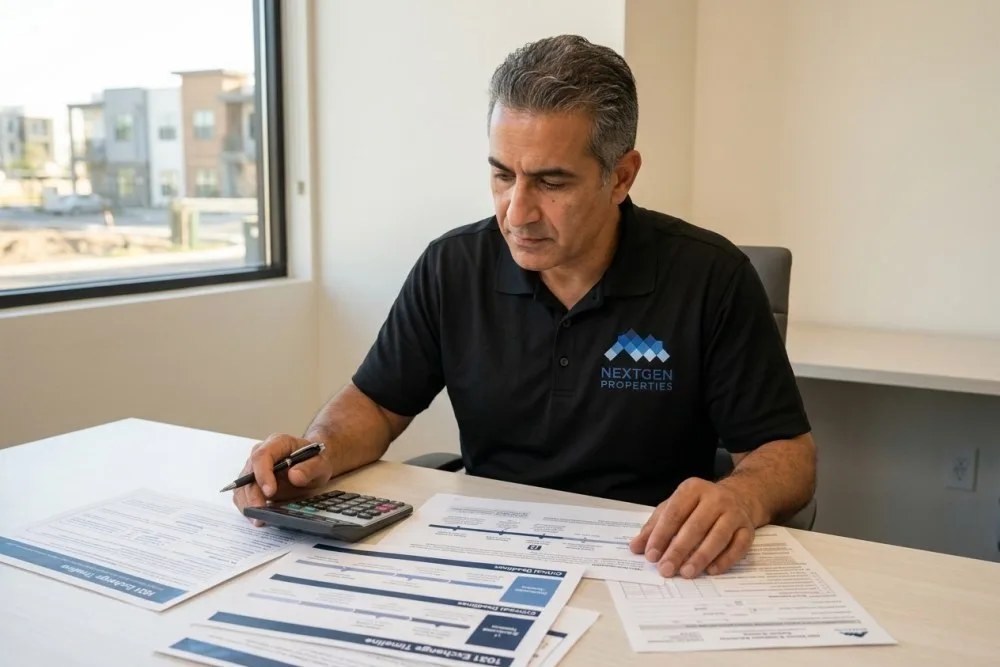
Critical Timelines: 45-Day and 180-Day Rules
Every 1031 exchange operates under two non-negotiable deadlines that begin the day you close on the sale of your relinquished property. Missing either one kills the exchange entirely, and no extensions are granted for any reason.
45-Day Identification Period
Within 45 days of selling your relinquished property, you must provide a written, signed identification of potential replacement properties to your qualified intermediary. The identification must be specific: street address or legal description, not vague descriptions like 'a property in Austin'.
You can identify replacement properties using one of three rules:
- Three-Property Rule: Identify up to three properties regardless of value
- 200% Rule: Identify any number of properties as long as their combined fair market value does not exceed 200% of the relinquished property's value
- 95% Rule: Identify any number of properties of any value, but you must acquire at least 95% of the total value identified
180-Day Exchange Period
The replacement property must be purchased by the earlier of two possible dates: 180 days after the date the relinquished property is transferred in the exchange, OR the due date of the taxpayer's return for the taxable year in which the relinquished property is transferred.
This creates a critical planning consideration for late-year sales. A taxpayer who sold real estate and began a 1031 Exchange on or after October 17, 2025 must close on the new replacement property by April 15, 2026. If the investor files an extension to file the 2025 tax return, they will then have until June 17, 2026, to close on the property – the full 180 days.
Qualified Intermediary Requirements
A 1031 exchange requires a qualified intermediary (QI). The IRS mandates a QI to handle funds and paperwork—without one, the exchange is disqualified. The QI must be completely independent from the taxpayer.
The party must not be the actual taxpayer, an employee of the taxpayer or a close relative. Furthermore, the IRS restricts anyone who has acted as your agent within the two years preceding the exchange. This means your current accountant, attorney, real estate professional or financial advisor cannot serve as your QI.
QI Selection Criteria
Not all qualified intermediaries are created equal. QIs are unregulated, so choosing the wrong one can trigger taxes or risk your funds. Key factors to evaluate include:
- Financial Security: The QI should segregate funds for each exchange into separate accounts held distinctly for the benefit of each individual exchanger. A segregated account protects an investor in the event that a QI runs into financial difficulty or declares bankruptcy
- Professional Credentials: Membership in organizations like the Federation of Exchange Accommodators (FEA)
- Fee Transparency: Most qualified intermediaries charge around $500 to $2,500 per transaction
- Experience: When choosing a Qualified Intermediary, the two most critical factors for evaluation are safety and security of exchange funds and competency of staff
QI Responsibilities
The exchanger must assign to the Qualified Intermediary their contractual interest as seller of the relinquished property and their contractual interest as buyer of the replacement property. Because the Qualified Intermediary becomes an actual principal in the transaction, a reciprocal trade is created.
A QI must strictly follow IRS timelines, including the 45-day identification period for naming potential replacement properties and the 180-day purchase deadline. They are also responsible for preparing and executing IRS-compliant documents, such as the Exchange Agreement and Assignment of Contract.

Reverse 1031 Exchanges: When You Buy First
Reverse exchanges cost 3-6x more than forward exchanges — the premium for buying first ranges from $2,500 to $12,500
EAT fees dominate reverse exchange costs at up to $7,500 — nearly triple the maximum QI fees alone
You buy the replacement property before selling the relinquished property. This is useful in hot markets where you cannot wait to sell first. However, reverse exchanges are significantly more complex and expensive.
A 'pure' reverse exchange, where the taxpayer owns both the relinquished and replacement properties at the same time, is not permitted. An Exchange Accommodation Titleholder (EAT), acquires and holds the target property in a separate special purpose entity, typically a single member LLC. To complete a reverse exchange, the EAT will take title to either the relinquished property or the replacement property under a 'Qualified Exchange Accommodation Arrangement' (QEAA).
Reverse Exchange Costs
Costs run $5,000-$15,000+ in additional fees, significantly higher than forward exchanges. Reverse 1031 exchanges typically cost between $7,000 and $15,000 or more, excluding bridge financing interest. This includes QI fees ($750–$1,500), EAT fees ($3,000–$7,500+), legal and attorney fees ($2,000–$5,000+), and LLC formation costs ($500–$1,500).
You'll have to pay a holding fee, usually ranging from $1000 to $2000, depending on the holding period. You may also have to pay a setup fee to cover the creation and administration of the exchange purchase and sales agreement.
Reverse Exchange Timeline
The same 45/180-day deadlines apply in reverse: you must identify the relinquished property within 45 days and sell it within 180 days of acquiring the replacement. The EAT must transfer either the parked new property to you or the parked relinquished property to the buyer on or before 180 days and you have 45 days to report the potential relinquished property after acquisition by the EAT.
Delaware Statutory Trusts as Backup Strategy
A Delaware Statutory Trust (DST) is a legal entity that holds title to investment real estate and sells fractional interests to investors. DST interests qualify as like-kind property for 1031 exchanges, making them a popular option for investors who want to exit active property management. DSTs offer several advantages: no management responsibilities, diversification across multiple properties or markets, access to institutional-quality assets, and flexible investment amounts.
DST Investment Minimums and Structure
Minimum investments typically range from $25,000 to $100,000, varying by offering. DSTs typically have a minimum investment of $100,000 for 1031 Exchangers and $25,000 for cash investors.
A DST is a legal entity formed under Delaware law that allows passive, fractional ownership in real estate while qualifying as 'like-kind' replacement property under Section 1031. When you invest in a DST, you're purchasing a fractional beneficial interest in professionally managed, institutional-grade real estate. The structure enables you to participate alongside other investors in high-quality assets that would otherwise be out of reach individually, with typical purchase prices ranging from $30 million to $100 million.
DST Operational Restrictions
To qualify as a 'like-kind' replacement property for a 1031 exchange, a DST must adhere to a set of rules established in Revenue Ruling 2004-86. These rules (the 'Seven Deadly Sins') prevent the DST from being classified as a 'business trust,' which would make it ineligible for a 1031 exchange:
- No additional capital contributions are permitted after the DST offering is closed
- The trustee cannot refinance or renegotiate the existing loan or place new debt on the property
- The leases on the property cannot be modified or a new lease entered into unless the tenant is insolvent or in bankruptcy
- Sales proceeds cannot be reinvested
DST as 1031 Backup Option
DSTs are particularly useful when you cannot find a suitable replacement property within the 45-day identification period. Identifying a DST as one of your three properties gives you a reliable backup plan. The timelines for 1031 exchanges are strict: you have 45 days from the sale of relinquished property to formally identify potential replacement properties and 180 days to complete the purchase. DSTs can provide value when timelines are compressed, as they typically close within 3 to 5 business days following the sale of the relinquished property.

California's Aggressive Claw-Back Tax Enforcement
California's claw-back provision creates a unique tax trap for investors exchanging out of state. California regulations employ a 'claw back' provision that requires any gain in property value accrued in California to be subject to California state taxes, regardless of whether or not that property was exchanged for one in another state.
Claw-Back Mechanism
The State of California Assembly passed legislation adding new sections to the California Revenue & Taxation code that require that 1031 Exchange investors that sell California property and purchase non-California replacement property to file an annual information return with the California Franchise Tax Board (FTB). The California State taxes that were previously deferred will be due if and when taxpayers sell their new non-California properties and elect to take their profits rather than continuing to defer taxes through another 1031 Exchange.
This is done using Form FTB 3840. This rule requires that if you perform a 1031 exchange and replace a California property with a property located outside of California, you must file an annual information return with the California Franchise Tax Board (FTB) for the year in which the exchange is completed and each subsequent year until the replacement property is sold in a taxable transaction.
Enhanced FTB Enforcement
For years, Form 3840 compliance was on the 'honor system.' Many investors ignored it without consequence. That has changed. The FTB has implemented the Enterprise Data to Revenue (EDR2) project. This AI-driven system cross-references federal 1031 filings (Form 8824) with state filings. If the IRS data shows you sold a California property in a 1031 exchange but the FTB sees no Form 3840 attached to your state return, automatic enforcement actions can follow.
Scope of California Liability
Does California tax the growth that happens outside of California? Generally, no. California only claws back the gain that accrued while the property was in California. When you cash out, you owe California tax on the original gain, but not on the subsequent out-of-state growth.
When you sell California property and exchange into property in another state, California does not forget about its share of the deferred gain. You are required to file FTB Form 3840 every single year to report the deferred gain from your exchange. And when you eventually sell the replacement property, California will tax its portion of the original gain at your then-current California income tax rate.
Common 1031 Exchange Mistakes to Avoid
Even experienced investors make costly errors that disqualify exchanges. Missing the 45-day identification deadline: The most common failure. Mark the date immediately after closing, and submit your identification with days to spare.
Fatal Exchange Errors
- Touching the Proceeds: Even briefly. If funds flow to you instead of the QI, the exchange is disqualified
- Trading Down in Value: Buying a cheaper replacement triggers boot on the difference
- Debt Replacement Issues: If your old property had a $400K mortgage but your new one only has $300K, the $100K difference is taxable boot unless offset with additional cash
- Disqualified Intermediary: Your attorney, CPA, or real estate agent cannot serve as your QI if they've worked for you in the past two years
Documentation and Compliance
The IRS is placing greater emphasis on clear, auditable transaction trails that connect the sale of the relinquished property to the acquisition of the replacement asset. This includes detailed records of sale proceeds, escrow transfers, Qualified Intermediary (QI) agreements, and identification documentation.
Form 8824 documents how the exchange was structured and how gain was deferred. The IRS uses it to confirm that the transaction followed Section 1031 requirements. The reporting year is based on when the relinquished property was sold, not when the replacement property was acquired. Form 8824 is filed with the 2026 tax return because that is the year the exchange began.
Transitioning to Passive Multifamily Investment
Many active multifamily investors use 1031 exchanges to transition into passive ownership through DSTs or syndications. An investor is tired of managing his property and has seen their cash flow reduce over time. They would like to finally go hands-off and get 'mailbox money'. The DST investment structure is one of the easier options for making this investment and deferring 15 years of appreciation and equity growth.
This strategy works particularly well with Orange County property management companies that have built substantial portfolios but want to reduce active involvement. DSTs stand out as a 1031 replacement property option for investors seeking passive income potential and diversified risk by allocating their 1031 Exchange proceeds across multiple institutional-grade DST properties that are typically much larger and out of reach of most individual investors.
Hybrid Strategies
You can exchange your relinquished property into a combination of direct property and DST interests. For example, invest 60% into a DST and 40% into a direct purchase. Both are like-kind real property. This hybrid approach gives you some control and liquidity (direct property) while maintaining passive income and management relief (DST portion).
2026 Market Considerations and Strategy
1031 exchanges continue to be one of the most powerful wealth-building tools in real estate, allowing investors to defer taxes, preserve capital, and scale portfolios strategically. As the market evolves heading into 2026, the rules governing these exchanges are becoming more precise, documentation-driven, and closely monitored by the IRS.
Legislative risk: Various proposals to limit or eliminate 1031 exchanges surface regularly in Congress. No changes have been enacted through early 2026, but investors should be aware that future legislation could affect exchanges in progress if a transition period is not provided.
Professional Team Assembly
As 1031 exchanges become more regulated and documentation-heavy, many investors are turning to specialized outsourcing support to reduce risk and improve execution. Managing compliance in-house can be time-consuming, complex, and prone to costly errors—especially for firms handling multiple transactions simultaneously. Dedicated 1031 compliance teams understand IRS expectations, transaction nuances, and audit triggers.
The optimal team includes:
- Experienced qualified intermediary with segregated accounts
- CPA specializing in real estate exchanges
- Attorney familiar with multi-state tax implications
- Property management company for market intelligence
Exit Strategy Planning
The most tax-efficient endpoint is holding the property until death. At that point, your heirs receive a stepped-up basis equal to the property's fair market value, and all deferred gains are permanently eliminated. This 'swap till you drop' strategy is a core element of real estate wealth building.
Alternatively, you can convert the property to your primary residence. After living in it for 2 years, you may qualify for the $250K/$500K primary residence exclusion. However, gains attributable to periods of non-qualifying use (years it was held as investment property) are not excludable.
For multifamily investors considering 1031 exchanges in 2026, success depends on early planning, professional guidance, and thorough understanding of both federal requirements and state-specific implications like California's claw-back taxes. The strategy remains powerful, but execution demands precision and expertise that justify working with experienced professionals throughout the process.
Frequently Asked Questions