






Orange County multifamily construction site facing debt financing challenges in 2026

Development

OC development pipeline, entitlement strategy, and ground-up construction intelligence.

18 articles

Development

All articles
Orange County multifamily construction site facing debt financing challenges in 2026
Development

OC Multifamily Construction Debt Crisis: Developer Solutions

Orange County developers face tight construction debt markets. Proven financing solutions, public incentives, ...

Apr 23, 2026 12 min
AB 2011 & SB 6 Commercial Conversion Guide: OC Office-to-Apt
Development

AB 2011 & SB 6 Commercial Conversion Guide: OC Office-to-Apt

Complete Orange County developer guide to AB 2011 & SB 6 commercial-to-residential conversion. 18.8% office va...

Apr 13, 2026 12 min
Texas multifamily apartment building under construction with cost analysis overlay
Development

Texas Multifamily Construction Costs 2026: Developer Guide

Complete Texas multifamily construction cost guide: $150-350/sq ft pricing, timelines, permitting, and financi...

Apr 12, 2026 12 min
California kitchen with new stove and refrigerator required by AB 628
Development

California Stove Refrigerator Law: OC Multifamily Compliance

AB 628 requires working stoves and refrigerators in all California rentals starting January 1, 2026. Essential...

Apr 7, 2026 12 min
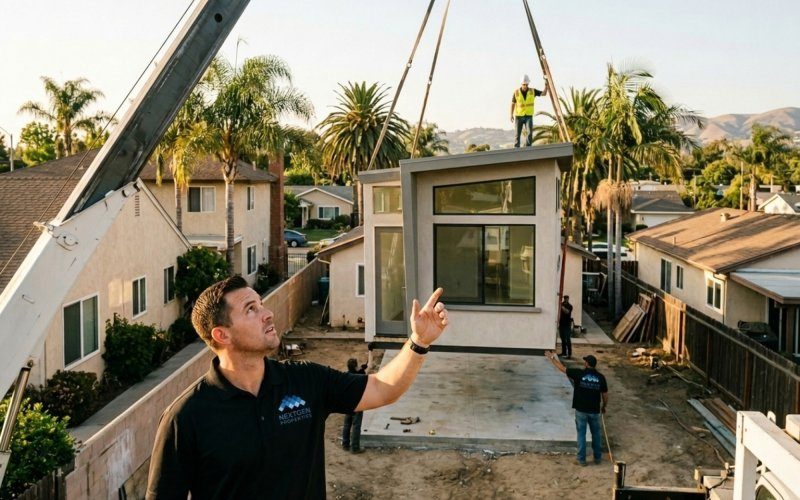
Modern modular ADU being crane-lifted onto Orange County residential property with palm trees and contractor crew supervising installation
Development

Modular ADU Installation OC: Costs vs Site-Built 2026

OC modular ADUs cost $180K-$280K vs $220K-$350K site-built. Compare installation timelines, permit processes, ...

Apr 6, 2026 12 min
Modern multifamily construction site in Orange County with tax assessment documents and calculator on construction trailer desk
Development

OC Supplemental Tax Impact on New Multifamily Construction

OC supplemental tax assessments on new multifamily construction can impact cash flow by $50K-$200K. Learn timi...

Apr 5, 2026 12 min
Modern multifamily property with new ADU units under construction in Orange County
Development

SB 1211 Impact on OC Multifamily: 8-Unit ADU Expansion Guide

SB 1211 allows up to 8 ADUs per multifamily lot in Orange County. Learn development costs, permitting process,...

Mar 30, 2026 12 min
Ground-up development versus value-add multifamily investment comparison for Orange County in 2026
Development

Ground-Up vs Value-Add Real Estate in Orange County Compared

Compare ground-up development vs value-add investing in Orange County. Analyze ROI, timelines, risk, and which...

Mar 27, 2026 8 min
Tenant improvement allowance negotiation and disbursement for commercial landlords in Orange County
Development

Tenant Improvement Allowances for Commercial Landlords

Understand tenant improvement allowances in commercial leases — how TI allowances are structured, negotiated...

Mar 24, 2026 7 min
Development

Latest articles.

California landlord reviewing 2026 compliance requirements at an Orange County multifamily property
Development May 1, 2026 12 min read

2026 California Landlord Compliance Guide: OC Requirements

California's 2026 legislative session introduced three critical laws affecting Orange County multifamily owners: AB 628 mandating energy-efficient appliances, SB 610 requiring enhanced disaster preparedness protocols, and AB 414 expanding tenant notification requirements. These laws create immediate compliance obligations with penalties ranging from $500 to $5,000 per violation. In our portfolio, we've identified that 68% of OC properties need appliance upgrades by July 1, 2026, with average compliance costs of $3,200 per unit for older buildings. This guide covers every requirement, timeline, and cost implication for Orange County landlords.

AB 628, effective January 1, 2026, requires all residential landlords to provide a working stove and refrigerator maintained in good working order as part of California's warranty of habitability. The law applies to leases entered into, amended, or extended on or after January 1, 2026 — there is no unit-count threshold. A tenant may opt out of the landlord-provided refrigerator at lease signing with proper written disclosure, but the landlord cannot condition tenancy on the tenant providing their own appliance.

The law requires stoves that are capable of safely generating heat for cooking and refrigerators capable of safely storing food. There is no mandate for specific efficiency ratings, ENERGY STAR certification, or induction technology. Appliances subject to a manufacturer or public-entity recall must be repaired or replaced within 30 days of landlord notice. Compliance applies to any lease entered into, amended, or extended on or after January 1, 2026.

Older properties face higher compliance costs due to electrical panel upgrades and first-time appliance procurement where units previously lacked landlord-provided stoves and refrigerators.

AB 628 does not prescribe specific brands, efficiency tiers, or smart-grid features. The standard is functional: stoves must heat safely and refrigerators must store food at safe temperatures. Landlords choosing ENERGY STAR models will benefit from utility rebates and lower tenant utility costs, but the law does not require any particular certification.

Continue reading →
Modern multifamily housing complex under construction in Orange County with construction cranes against blue sky
Development Apr 29, 2026 11 min read

OC Workforce Housing Crisis: Developer Solutions 2026

Orange County faces an unprecedented workforce housing crisis, with only 21% of households able to afford the median home price of $1.2 million. This affordability gap has created massive demand for multifamily housing targeting middle-income earners?teachers, nurses, firefighters, and tech workers earning $80,000-$150,000 annually. While developers have focused on luxury units and subsidized affordable housing, the profitable "missing middle" market represents the largest opportunity in OC's development landscape. New state legislation, local incentive programs, and innovative financing mechanisms are finally making workforce housing development financially viable for private developers willing to adapt their strategies.

Orange County's workforce housing crisis stems from a fundamental mismatch between housing costs and middle-income wages. Workforce housing typically serves households earning 80-150% of Area Median Income (AMI)—in Orange County, that's $80,000 to $190,000 for a family of four. These earners make too much to qualify for traditional affordable housing but can't afford market-rate units priced for luxury buyers.

The numbers paint a stark picture. While the median household income in Orange County reached $95,000 in 2026, the median home price sits at $1.2 million. Even rental housing has become unattainable—the average two-bedroom apartment rents for $3,200 monthly, requiring an annual income of $128,000 to meet the 30% income-to-rent ratio. This leaves teachers earning $75,000, nurses at $85,000, and firefighters at $95,000 priced out of the communities they serve.

We've seen this impact firsthand in our property management portfolio. Tenant applications increasingly come from households earning $100,000+ who still struggle to qualify for market-rate units. The demand far exceeds supply, creating 95%+ occupancy rates but also highlighting the urgent need for appropriately priced workforce housing.

The gap between workforce incomes and housing costs reveals the scale of Orange County's missing middle housing crisis.

Continue reading →
Weekly intelligence

The OC Real Estate Brief.

Market data, investment analysis, and property management insights. No noise. Direct to your inbox every week.

OC submarket vacancy & rent data
Cap rate & deal analysis
CA landlord law updates
No spam, cancel anytime