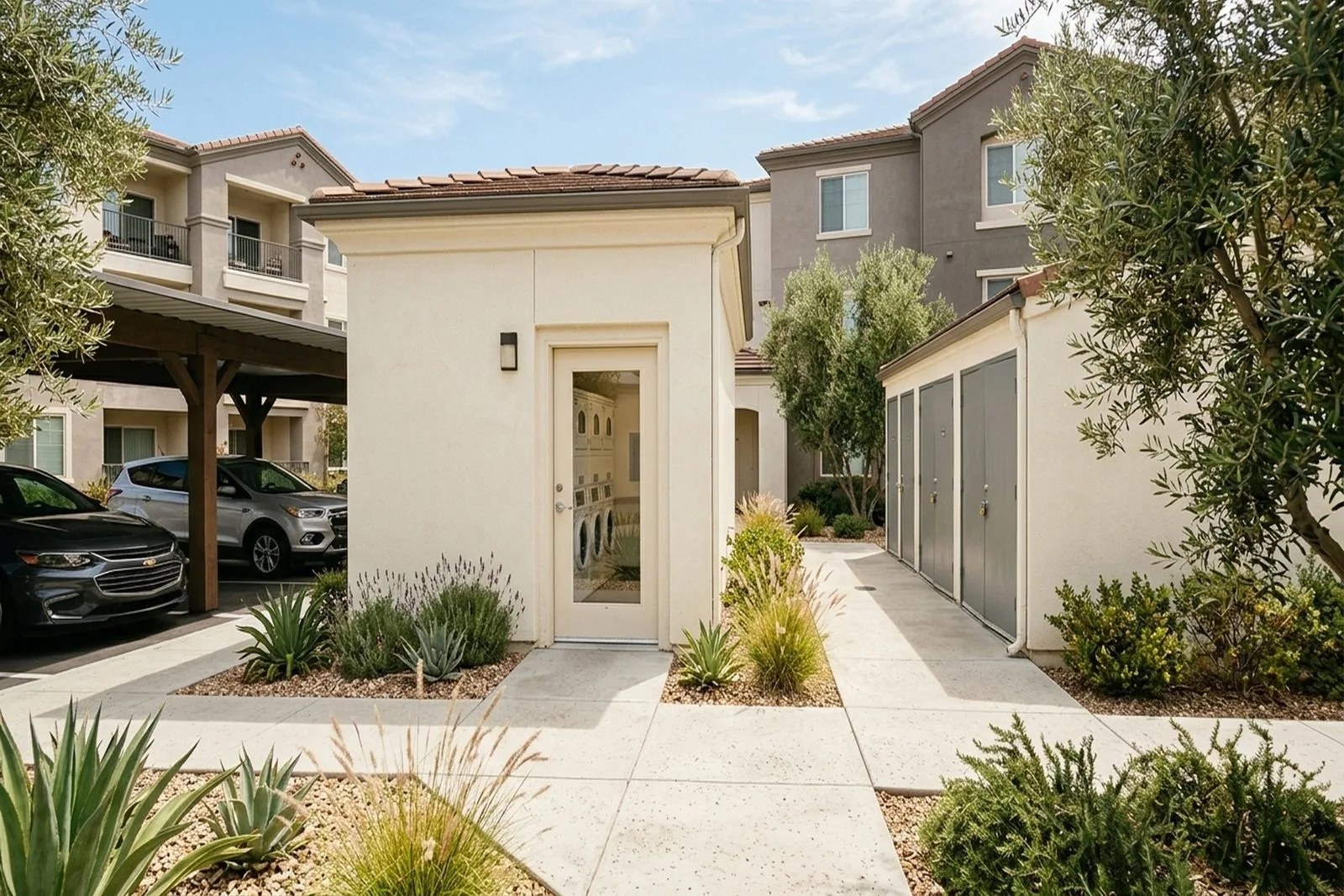
Rent is only one line on the income statement. Managed WiFi, RUBS utility billing, premium parking, on-site storage, and laundry programs each add $50–$150+ per unit per month in recurring income. On a 20-unit building at a 4.5% cap rate, deploying all five can add $400,000–$900,000 in asset value — without raising base rent a dollar.
When we underwrite an acquisition, we always model two NOI figures: what the property is producing today, and what it should be producing with full ancillary income in place. The gap is usually significant. Most mom-and-pop owned properties in Orange County are running on rent income alone, leaving substantial passive revenue untouched.
1. Whole-Complex Managed WiFi
Through NextGen WiFi, we install enterprise-grade access points throughout the property and offer internet as a built-in amenity. Roughly 70% of tenants upgrade, generating $250–$500/month for most properties — completely passive after installation.
On a 30-unit building with average $3,600/mo 2BR rents, these five income streams add $7,200/mo in NOI — roughly $86,400/yr. Managed WiFi at $55/unit and RUBS together account for nearly 60% of that total.
| Income Stream | Basis | Monthly NOI Add |
|---|---|---|
| RUBS Utilities | $90/unit × 30 | $2,700 |
| Managed WiFi | $55/unit × 30 | $1,650 |
| Premium Parking | 15 spaces × $100 | $1,500 |
| Storage Units | 10 units × $75 | $750 |
| Laundry | $20/unit × 30 | $600 |
2. RUBS Utility Billing
On a 20-unit OC building with a $3,400/month combined utility load, a RUBS program typically recovers $2,500–$3,000/month (80–90% of actual cost). That's the single highest-impact ancillary income change for most properties. California permits it with proper lease disclosure.
3. Premium and Reserved Parking
In Orange County, covered or reserved parking commands $75–$175/month per space. EV charging spaces can command $100–$200/month. A 20-unit property with 8 premium spaces at $100/month is generating $800/month in dedicated parking income — $9,600/year straight to NOI.
4. On-Site Storage Units
Small lockable units (4x4 to 5x5) rent for $50–$100/month in Orange County. A modest 10-unit storage program at $75/month average generates $750/month — $9,000/year on previously unused square footage. Occupancy on storage units in well-managed properties tends to run 90%+.
5. Laundry Program Optimization
Well-run laundry programs on mid-size OC properties generate $400–$800/month. Make sure you're getting at least 50–60% of gross receipts, and that the contract includes regular equipment maintenance.
“Every time we take over a property, we audit ancillary income on day one. It's almost always the fastest path to a material NOI improvement — before any rent increase touches a lease.”
— Chris Kerstner, CEO, NextGen Properties
Putting It All Together
WiFi upgrades: $300/month. RUBS recovery: $2,500/month. Premium parking (6 spaces): $600/month. Storage (8 units): $500/month. Laundry optimization: $400/month. Total: $4,300/month in new NOI — $51,600/year — without changing a single lease's base rent.
At a 4.5% cap rate, that's $1,147,000 in added asset value. If you'd like a free ancillary income audit on your property, reach out to our team.
6. Pet Fees and Pet Rent
California's AB 12 folded pet deposits into the one-month security deposit cap, but monthly pet rent is not affected. Charging $25–$75/month per pet is standard in OC. On a 20-unit building where 30% of units have pets, that is 6 pets × $50/month = $300/month, $3,600/year. Pet rent is pure NOI — there is no corresponding expense. Additionally, pet-friendly policies expand your tenant pool and reduce vacancy. The key risk: pet damage that exceeds the security deposit. Mitigate with move-in pet inspections, breed and weight restrictions (where legally permissible), and documented pet addendums.
7. EV Charging Stations
EV adoption in Orange County is among the highest in the nation. Level 2 charging stations cost $2,000–$5,000 per port installed. Properties that offer reserved EV charging command $100–$200/month per space in premium parking fees. California's AB 2355 and SB 1406 require multifamily buildings to provide EV-ready wiring for a percentage of parking spaces — compliance today positions you ahead of future mandates and generates revenue in the interim.
8. Smart Package Lockers
Package theft is the number-one complaint in apartment communities nationally. Smart locker systems cost $8,000–$15,000 installed for a 20–40 unit building. Some providers offer revenue-share models at no upfront cost. Revenue potential: $3–$5/unit/month in tenant-paid locker fees, plus reduced liability and management time from package-related complaints. The retention benefit is meaningful — tenants who receive packages reliably are less likely to move.
Implementation Sequence
Don't try to launch everything at once. The recommended rollout for a newly acquired OC property:
- Month 1–2: RUBS implementation (highest impact, requires lease addendums at turnover)
- Month 2–3: Laundry audit and contract renegotiation (quick win, no tenant impact)
- Month 3–4: Premium parking and storage program launch
- Month 4–6: Managed WiFi installation and activation
- Month 6–12: Pet rent program, EV charging, and package lockers as capital allows
A disciplined 12-month ancillary income rollout on a 20-unit OC building typically adds $4,000–$6,000/month in NOI — $48,000–$72,000/year — representing $960,000–$1,440,000 in asset value at a 5% cap rate.
Frequently Asked Questions