Cash for keys tenant buyout agreements have become increasingly complex under California AB 1482 and evolving local rent control ordinances. While AB 1482 does not prohibit or regulate buyout offers, but agreements obtained by means of duress, harassment or coercion may not be enforceable and the tenant is not required to accept any buyout offer, cities like Los Angeles, Santa Monica, and Santa Ana have implemented strict disclosure requirements and procedural safeguards. The average buyout amount in Los Angeles was $25,068.87 from 2019-2025, while Orange County landlords typically offer two to three months of rent, ranging from $4,400 to $6,600 based on median rents. Understanding disclosure requirements, cancellation periods, and local rent stabilization rules is crucial for compliance and successful negotiations in 2026.
AB 1482 Framework for California Buyout Agreements
The California Tenant Protection Act (AB 1482) fundamentally changed the landscape for cash for keys agreements across the state. AB 1482 is a statewide law that went into effect on January 1, 2020 and expires on January 1, 2030, requiring landlords to have just cause to terminate tenancies and limiting annual rent increases to no more than 5% + local CPI or 10% whichever is lower.
While AB 1482 does not prohibit or regulate buyout offers, these offers are strictly regulated by some local rent control ordinances to protect tenants from harassment or coercion, creating a complex patchwork of state and local requirements. Tenants may not waive their rights to AB 1482 protections and any agreement to do so is void as contrary to public policy.

All tenants in units covered by AB 1482 must receive written notice explaining just cause and rent cap protections, but this disclosure requirement differs from the specialized buyout disclosure rules implemented by individual cities. The state framework provides baseline tenant protections while allowing local jurisdictions to add stricter requirements.
Los Angeles RSO Disclosure Requirements
Los Angeles operates the most comprehensive tenant buyout regulation system in California. Before making a buyout offer or agreement, landlords must give tenants the RSO Disclosure Notice which must be signed and dated, and the Buyout Agreement must be in the primary language of the tenant.
The 2026 rules strengthen disclosure requirements to prevent landlords from offering buyouts casually or without transparency, requiring landlords to provide city-approved disclosure forms before making any offer, which must be provided in the tenant's primary language if available.
Required Los Angeles Disclosure Elements
The LA disclosure process involves multiple mandatory components. Disclosure notices must inform tenants that they may rescind agreements within 30 days or at any time if requirements are not met, and tenants are not required to accept a buyout agreement. The disclosure must state that tenants may rescind agreements within 30 days or at any time if requirements are not met, and tenants are not required to accept any buyout agreement.
The Buyout Agreement must contain language in 12 point bold above the signature line stating "You, (tenant name), may cancel this Buyout Agreement any time up to 30 days after all parties have signed this Agreement without any obligation or penalty". The landlord must file the Disclosure Notice and executed Buyout Agreement with LAHD within 60 days of both parties signing.
Santa Monica Minimum Buyout Requirements
Santa Monica's $38K average buyouts dwarf Orange County's $2.4K-$7.2K typical range — local regulations create 5-15x cost differences
Santa Monica has implemented some of California's strictest cash for keys regulations. Santa Monica regulates all cash buyouts of tenants, requiring landlords to provide tenant disclosures about rights before an offer is made and submit agreements to the city after reaching agreement.
In 2024 the city passed a law requiring all buyouts to meet new minimum amounts based on bedrooms, with these minimum amounts equal to the mandatory relocation fee for no-fault evictions. City rules provide strong tenant protections including the right to refuse cash for keys agreements (all buyouts must be voluntary) and the right to cancel the agreement and return to the unit within 30 days after signing.

The average buyout for tenants in Santa Monica was $38,037 in 2021 and $35,693 in 2020, reflecting the city's high housing costs and strong tenant protections. When properly negotiated, cash for keys buyouts can be substantial, with some tenants receiving over $20,000 in buyouts, sometimes even more.
Orange County Cash for Keys Compliance
Orange County jurisdictions generally follow state AB 1482 requirements without additional local buyout regulations, though Santa Ana's rent stabilization ordinance adds complexity. Santa Ana's Rent Stabilization and Just Cause Eviction Ordinance limits rent increases to the lower of 3 percent per year or 80 percent of CPI change for certain residential units and provides just cause eviction protections.
The maximum allowable rent increase for Santa Ana from September 1, 2025, through August 31, 2026, is 2.42%, creating significant value gaps that make buyout negotiations attractive for both parties. Costa Mesa property management operates under AB 1482 without additional local buyout disclosure requirements.
Typical Orange County Buyout Amounts
In most Orange County situations, cash-for-keys payments fall in the range of one to three months' rent, with Placentia's median rent of $2,388 suggesting reasonable offers in the $2,400 to $7,200 range. Fullerton landlords typically offer relocation payments of roughly $4,400 to $6,600 (two to three months of the Census median rent of $2,194).
Cash for keys payments vary dramatically based on multiple factors, but most offers fall between $2,000 and $20,000, with national averages clustering around $3,000-$8,000 for standard single-family properties representing the sweet spot where property owners save money compared to eviction while providing meaningful relocation assistance.
Disclosure Timing and Procedures
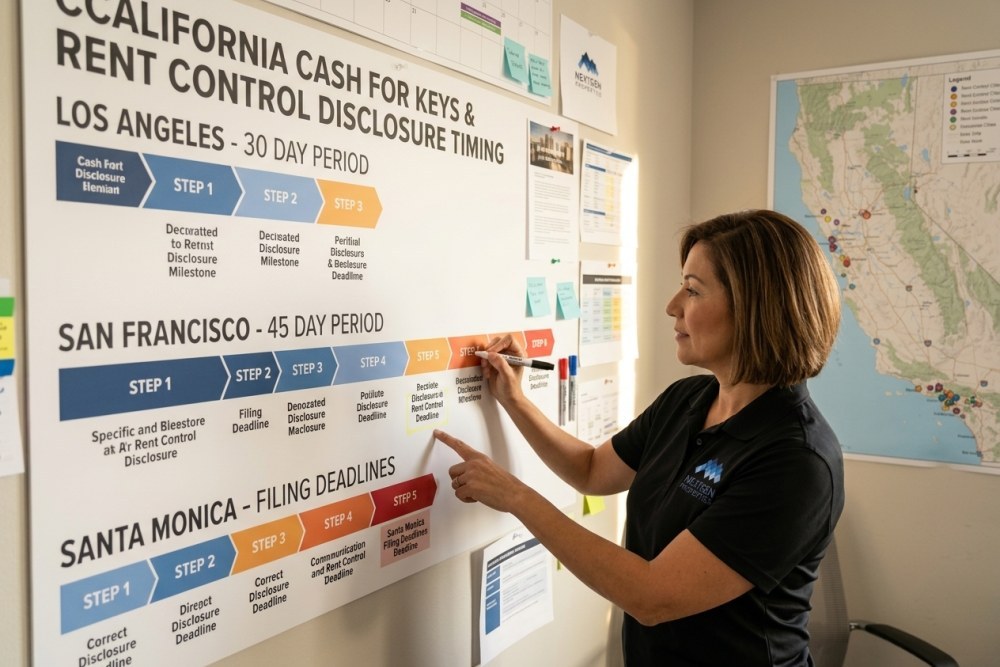
Proper timing of disclosures is critical for legal compliance across different jurisdictions. In Los Angeles, landlords must provide tenants with a disclosure of their rights before presenting a buyout offer, while San Francisco requires compliance with Administrative Code Chapter 37, including delivering a disclosure notice and giving tenants at least 30 days to consider the offer before signing, with landlords then filing the final agreement with the Rent Board.
In unincorporated Los Angeles County, landlords must serve tenants with a Disclosure Notice at least 45 days before signing and must ensure that both the Disclosure Notice and buyout agreement are in the tenant's primary language. The agreement must include specific language provided by the County DCBA detailing tenant rights, and landlords have 10 days after signing to provide a signed copy to tenants and file required documents with DCBA.
Cancellation and Rescission Rights
California jurisdictions provide varying cancellation periods that tenants must understand. Some cities provide specific windows to cancel after signing buyout agreements, with Los Angeles allowing tenants 30 days to rescind and San Francisco allowing 45 days to rescind after signing.
A landlord's failure to follow procedural rules gives tenants certain rights and should not be ignored during buyout negotiations where tenants need as much leverage as they can get. If owners do not comply with disclosure requirements, tenants have the right to cancel the Buyout Agreement for any reason at any time without obligation or penalty, and may assert an affirmative defense to an Unlawful Detainer action with potential private civil remedies.
Tenants can refuse or rescind deals within 30 days, providing important protection against coercive agreements. This rescission period allows tenants time to fully consider the implications of leaving rent-stabilized housing and seek legal counsel if needed.
Local Rent Control Impact on Buyouts
Local rent control ordinances significantly affect buyout valuations and procedures. The LA RSO applies to most residential rental properties with two or more units built before October 1, 1978, with RSO protections layered on top of AB 1482 and significantly stronger requirements including mandatory written disclosure of tenant rights before negotiating any buyout or cash-for-keys agreement.
Los Angeles City Council approved a major amendment to the Rent Stabilization Ordinance in December 2025, significantly reducing the allowable rent increase formula for rent-controlled properties, with the ordinance becoming effective January 24, 2026 and the new formula taking effect July 1, 2026. Lower caps, reduced CPI application, and removal of prior add-ons limit owners' ability to offset rising expenses, making predictable rent growth more constrained.
Santa Ana Rent Stabilization Impact
Santa Ana's ordinance creates additional complexity for Orange County landlords. The rent stabilization cap only applies to buildings built on or before February 1, 1995 pursuant to the Costa-Hawkins Rental Housing Act, with mobilehome space caps applying only to parks established before 1990. Only one rent increase is allowed in a 12-month period and cannot exceed the allowable increase, with the City publishing maximum allowable increases by June 30 each year effective September 1.
Structuring Compliant Buyout Agreements
Well-structured agreements protect both parties while ensuring legal compliance. Key agreement components include complete identification of all parties, property address and legal description, exact payment amount and currency, when and how payment will be delivered, specific move-out date and time, detailed property condition requirements, process for key surrender and property inspection, mutual release of claims, and signatures with dates from all parties.
Agreements should include specific move-out dates, property condition requirements (all personal property removed, no damage beyond normal wear, all keys and garage remotes returned), and payment structure (such as half upon signing, half at move-out after satisfactory walkthrough). Unlike eviction where tenants can simply leave, cash for keys agreements require cleaning and maintaining the property to specified standards.

Terms must be documented and agreed to by signature to prevent disputes, with landlords present for move-out to confirm unit vacancy, collect keys, and immediately re-key the unit. Security deposits should be processed as usual unless negotiated as part of the cash-for-keys deal, typically meaning deductions for damage beyond normal wear and tear with itemized lists returned to former tenants.
Negotiation Best Practices and Legal Compliance
Effective negotiations require understanding market conditions and legal boundaries. Effective negotiation requires preparation, understanding leverage, and clear communication, with research into local eviction costs and timelines providing negotiating baselines. Landlords should negotiate fairly and offer reasonable amounts based on going market rates, with some markets starting at $500 while others requiring up to two months' rent.
Landlords must not harass tenants or make threats to coerce acceptance of cash-for-keys offers. Extra care must be taken not to negotiate differently with tenants in protected classes under fair housing laws, as different offers to minority tenants could be interpreted as violations whether offering lower amounts (implying unwillingness to pay equally) or higher amounts (implying greater anxiety to remove specific tenants).
Documentation and Filing Requirements
Proper documentation protects all parties and ensures compliance. Landlords must serve Disclosure Notices before any buyout discussions and file both Disclosure and Buyout Agreements with LAHD within 60 days. Agreements should be sent to city councils for filing, with buyout agreements typically filed 31 days to 60 days from the agreement date.
Tenants should document property condition with photos and videos before negotiations begin, as this evidence supports claims of proper maintenance and commitment to leaving property in good condition. Renters should confirm rescission timelines with cities, keep copies of every signed page, and request proof of filing where required, with the process moving from disclosure to negotiation to written contract and potentially city filing.
Legal Risks and Enforcement Actions
Non-compliance with buyout regulations carries significant penalties. If landlords skip required disclosures, fail to file paperwork, or omit mandated language, compliance errors are not minor technicalities and can completely undermine buyout strategies. Failure to provide proper disclosure can void agreements and expose landlords to penalties.
Missteps can invalidate buyout agreements and expose landlords to fines, tenant rescission rights, potential legal defenses in eviction actions, and potentially criminal liability. Tenant lawyers routinely discover landlord violations during consultations, and when tenant attorneys become involved showing lawsuit grounds, landlords tend to become more motivated to complete buyout agreements and avoid litigation, significantly increasing buyout values when landlord violations are established.
Tax Implications for Buyout Recipients
Tax considerations affect both parties in buyout agreements. Whether buyouts constitute taxable income is a critical point often not discussed, with general guidance to err on caution and assume at least some taxation, particularly if settlements fail to incorporate compensation for generally non-taxable events, making it critical to craft agreements that properly account for non-taxable events.
Advising on taxes requires consultation from tax professionals, but it's wise to consider tax implications from the start. Landlords should recommend tenants consult tax advisors to understand potential obligations, while agreement structures can potentially minimize tax exposure through proper characterization of different payment components.
2026 Outlook and Emerging Trends
California's regulatory environment continues evolving with new tenant protections. Los Angeles continues updating tenant protection rules as the city prepares for 2026 Cash for Keys reforms, strengthening requirements for disclosures, timelines, and negotiation fairness under Los Angeles Municipal Code Section 151.31. The 2026 rules strengthen disclosure requirements to prevent landlords from offering buyouts casually or without transparency, aiming to stop informal conversations that pressure tenants without documenting the process.
Santa Ana City Council adopted a new ordinance strengthening renter protections by limiting certain rent-setting software for residential properties, approved March 3, 2026, responding to concerns about tools using nonpublic market data to influence pricing, with the ordinance banning price-fixing software and empowering tenants to take civil action.
The trend toward stricter disclosure requirements, longer consideration periods, and enhanced tenant protections will likely continue expanding across California jurisdictions. Property managers must stay current with evolving regulations while developing compliant procedures that protect tenant rights and landlord interests.
Frequently Asked Questions