Commercial and residential property management share surface similarities — both involve tenants, leases, maintenance, and monthly accounting. But the underlying expertise required is fundamentally different, and hiring the wrong manager for a commercial asset can cost you significantly more than the management fee you saved. Here’s what distinguishes professional commercial management from residential, and why it matters for your NOI.
When a property owner calls a residential property management company to manage their small strip center or office building, one of two things usually happens: either the management company politely declines, or they take the assignment and fumble it — because the skills and systems that make a great residential manager have limited transferability to commercial assets.
At NextGen Properties, we manage over 150,000 square feet of commercial space alongside 750+ residential units. Both asset types receive the same operational rigor — but with clearly differentiated expertise. Here’s what that expertise actually involves.
Lease Structures: NNN, Gross, and Modified Gross
A residential lease is relatively standardized. Commercial leases are far more variable in their expense allocation:
Triple-Net (NNN) Lease: The tenant pays base rent plus their proportionate share of property taxes, building insurance, and common area maintenance (CAM) expenses. Common in retail strip centers, industrial properties, and office buildings. The management complexity comes from tracking actual expenses and reconciling them against tenant estimates annually.
Gross Lease: The landlord pays all operating expenses and charges a flat rent that includes those costs. Simpler to administer but leaves the landlord exposed to expense increases. Common in office buildings and professional space.
Modified Gross Lease: A hybrid — certain expenses paid by the landlord, others by the tenant, with allocation negotiated specifically. Common in smaller commercial buildings and mixed-use properties. Requires the manager to track each tenant’s expense obligations separately.
A manager who doesn’t understand these structures will make billing errors, miss pass-through opportunities, and fail to enforce expense recovery provisions — directly reducing your NOI.

CAM Reconciliation: The Annual Commercial Accounting Exercise
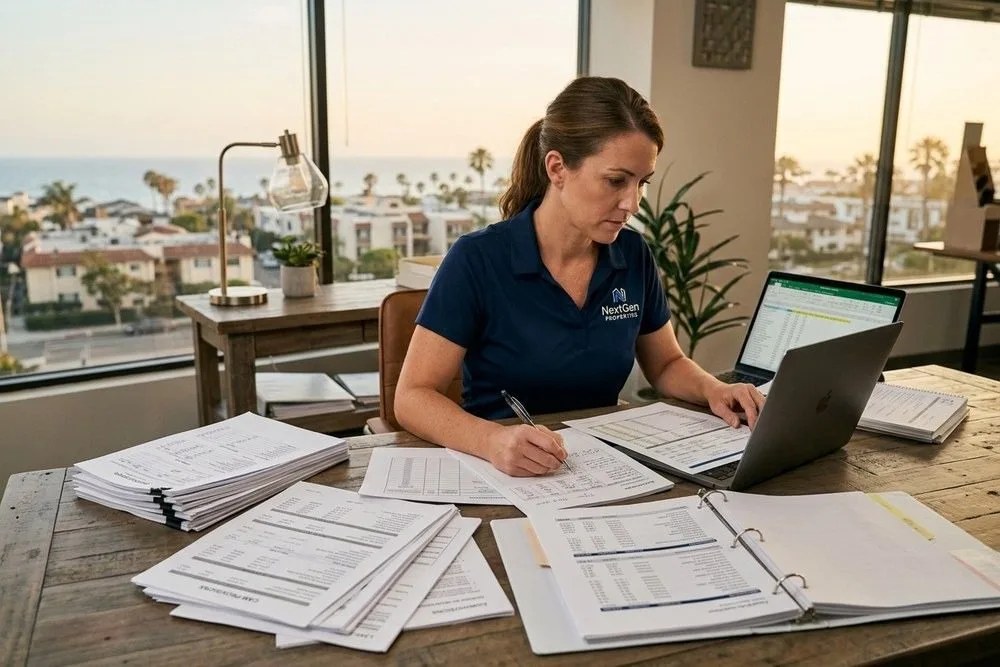
For NNN and modified gross leases, Common Area Maintenance (CAM) reconciliation is one of the most important — and most frequently mishandled — processes in commercial property management.
At the beginning of each lease year, the landlord estimates total CAM expenses and bills each tenant a monthly estimated payment based on their pro-rata share (leased SF ÷ total leasable SF). At year-end, the manager compares actual expenses against estimates and issues adjustments to each tenant. This requires:
- Detailed tracking of all operating expenses throughout the year
- Understanding of which expenses are CAM-recoverable under each tenant’s specific lease (exclusions vary)
- Accurate calculation of each tenant’s pro-rata share
- Professionally formatted reconciliation statements complying with lease requirements
Errors in CAM reconciliation are expensive in both directions: under-billing loses money; over-billing creates disputes and potential legal liability.
Tenant Improvement Allowances
Commercial leases often include Tenant Improvement (TI) allowances — money from the landlord to help tenants build out their space. Managing TI requires the manager to approve tenant contractor plans, inspect work in progress, certify completion before disbursing funds, ensure contractors are properly licensed and insured, and account for TI disbursements correctly in owner financials. This process is completely foreign to residential management. Residential managers tasked with commercial TI oversight almost invariably handle it poorly. See our dedicated guide on tenant improvement allowances for commercial landlords.
Multi-Tenant Coordination
Commercial tenants interact with each other in ways residential tenants don’t: shared parking creates conflicts, deliveries block common areas, anchor tenant operations affect small tenants, and operating hours must be coordinated. Managing a retail center requires the manager to proactively manage the tenant mix and relationships — communicating common area policies, mediating conflicts, coordinating shared building systems — so the center operates as a coherent whole rather than a collection of independent tenants sharing a parking lot.
Commercial Vacancy and Leasing
When a residential unit becomes vacant in OC’s 2.8% vacancy market, it typically leases within 2–4 weeks with good marketing. Commercial vacancy is entirely different:
- Commercial leases are negotiated — term, rent, TI allowance, free rent, renewal options, and expense allocation are all on the table
- Vacancy periods are longer: 3–12 months for small commercial, 12–24+ months for larger spaces
- Commercial leasing requires broker relationships — most commercial tenants are found through commercial broker networks, not Zillow
A residential property manager without commercial broker relationships and lease negotiation experience is marketing your vacant commercial space in the dark.
Reporting Differences
Commercial property management reporting requires more than residential. In addition to standard income and expense statements, commercial management typically requires: tenant-by-tenant rent roll with lease structure and expiration, annual CAM reconciliation statements per tenant, TI allowance tracking and disbursement records, lease expiration schedule with renewal option dates, and budget-vs-actual variance analysis.
Which Owners Need Commercial Expertise?
You need a management company with genuine commercial expertise if you own any retail property, office buildings, industrial or flex-industrial space, mixed-use properties with ground-floor retail, or any property with NNN leases or CAM recovery provisions. The common thread is commercial lease structure. If your property has tenants who pay CAM, the management team needs to know how to administer it — and that requires specific training, systems, and experience that most residential property managers don’t have.
Frequently Asked Questions