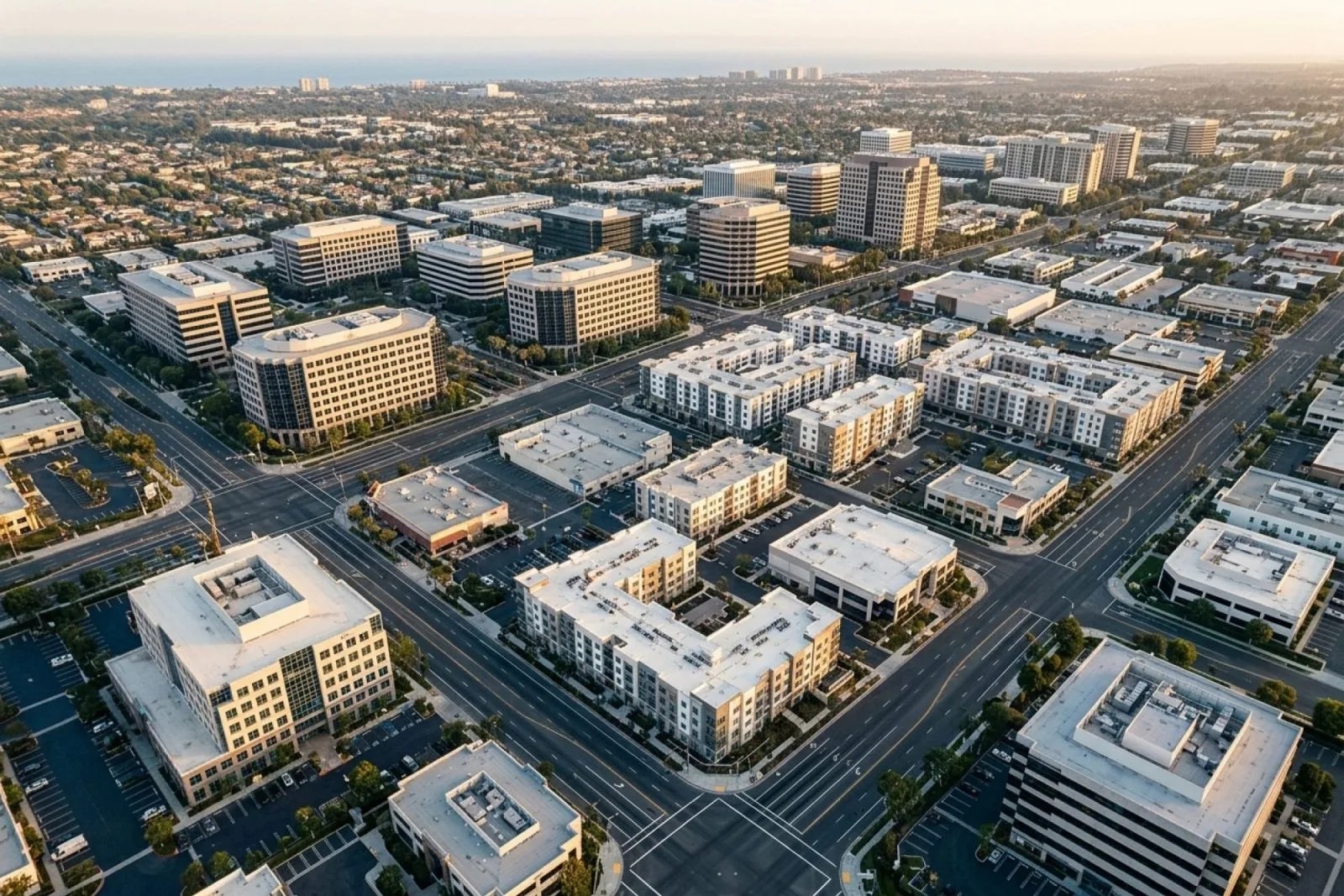
Orange County's office vacancy has climbed to 18.8%, creating unprecedented opportunities for commercial-to-residential conversion under AB 2011 and SB 6. These California laws provide streamlined, ministerial approval pathways that bypass traditional zoning restrictions and CEQA review, dramatically reducing approval timelines from 2-3 years to 8-12 months. With conversion costs ranging $150-350/SF compared to $600+/SF for new construction, developers can achieve superior returns while addressing the county's housing shortage. Recent AB 2243 amendments expand eligibility to regional malls up to 100 acres and eliminate density limits for existing building conversions, opening new opportunities throughout Orange County's commercial corridors.
Orange County's Office Conversion Opportunity
Orange County's commercial real estate landscape has shifted dramatically post-pandemic. Office vacancy rates reached 18.82% in 2024, while direct vacancy held at 11.7% countywide with stronger performance in Irvine Spectrum and Airport Area submarkets. This represents millions of square feet of underutilized space ripe for residential conversion.
UrbanFootprint estimates these conversion laws could provide California an additional 1.6 to 2.4 million residential units, including up to 400,000 low-income homes requiring no government subsidies. In our Orange County portfolio alone, we've identified dozens of properties meeting AB 2011 and SB 6 criteria, particularly in Costa Mesa's commercial districts and Anaheim's older office corridors.
The economic fundamentals strongly favor conversion projects. Acquiring a completed multifamily property costs about $600 per square foot and new developments run $588 per square foot on average, while converting an existing office building averages $685 per square foot. However, these figures don't account for the streamlined approval benefits and reduced timeline risks.
AB 2011: Ministerial Approval for Affordable Housing
AB 2011 (Wicks) was signed into law by Governor Newsom on September 28, 2022 and went into effect on July 1, 2023. AB 2011 creates a ministerial, California Environmental Quality Act (CEQA)-exempt, time-limited approval process for multifamily housing developments on commercially zoned property.
The legislation provides two distinct options: one for 100 percent BMR projects and a second for mixed-income (typically 15 percent BMR) projects located specifically on "commercial corridors". To be eligible under AB 2011, a rental project must include either 8% of the units for very low income households and 5% of the units for extremely low income households, or 15% of the units for lower income households.
All construction workers must be paid prevailing wages as established under California's Prevailing Wage Law. For projects that develop 50 or more housing units, additional labor standards apply, including participating in state-approved apprenticeship programs.
AB 2243 Amendments Expand Opportunities
AB 2243 amends AB 2011 with the intent to ensure more properties are eligible for the benefits, modify property and project criteria to allow greater use of this streamlining tool, and clarify provisions that proved difficult to interpret. One of AB 2243's most impactful changes is the revision of the prior 20-acre maximum site criteria under both AB 2011 and SB 6 to allow development on sites up to 100 acres containing a regional mall.
For projects to convert an existing nonresidential structure to residential uses, AB 2243 provides that there is no density limit, recognizing that conversion projects have both benefits and challenges warranting this additional flexibility. This is game-changing for Orange County developers looking at large office buildings or retail centers.
SB 6: Middle-Class Housing Without Rezoning
Senate Bill 6, commonly known as the Middle-Class Housing Act of 2022, introduces significant changes to housing development regulations within commercial zones to convert vacant offices into apartments and condominiums. SB 6 does not provide a ministerial approval pathway, but does allow residential use on commercially zoned property without requiring a rezoning.
To invoke the law, applicants must commit to both prevailing wages for workers and "skilled and trained workforce" requirements, although the law provides an "off ramp" if fewer than two bidders bid for a contract under the skilled and trained workforce requirement. SB 6 does not require any affordable housing to be included in the project.
SB 6 allows residential development within areas zoned for office, retail or parking uses when specific conditions are met, with an effective period from July 1, 2023 through January 1, 2033. A developer may utilize SB 6 in conjunction with other streamlining statutes like SB 35 that provides permit streamlining for qualifying multifamily projects.
Cost Analysis: Conversion vs New Construction
Office-to-residential conversions cost $300-400/SF versus $500-600/SF for ground-up development - a potential 33% cost savings favoring conversion projects
Commercial-to-residential conversion offers significant cost advantages over ground-up development. Developers should plan on spending $500 to $600 per square foot on an office-to-residential conversion, though this varies substantially based on building condition and conversion scope.
In our Orange County experience, conversion costs typically range $150-350/SF for gut renovations of suitable buildings. Construction costs for a ground-up residential development in Manhattan could run $500 to $600 per square foot, while a conversion generally costs between $300 and $400 per square foot, with some projects achieving $325 per square foot.
Conversions take less time to complete than constructing a new building, generally taking 18 to 20 months to acquire the first temporary certificate of occupancy followed by six to 10 months for final completion (totaling 24 to 30 months), while ground-up development would run "at least four years".
Hidden Costs and Considerations
Beyond basic construction costs, Orange County developers must account for seismic upgrades, parking modifications, and building system replacements. A 2023 report by SPUR and the Urban Land Institute San Francisco estimated that conversion projects cost between $472,000 and $633,000 per unit, not including seismic upgrades that may be required when converting older commercial structures.
We've found success by targeting newer office buildings (1990s-2000s) with efficient HVAC systems and adequate parking ratios. These properties typically require $200-275/SF in conversion costs versus $350+/SF for older buildings needing comprehensive system upgrades.
Site Selection and Eligibility Requirements
Both AB 2011 and SB 6 require properties to be located within a zone where office, retail, or parking are a principally permitted use. For AB 2011 mixed-income projects, sites must also be located on a "commercial corridor" - generally a street with a right-of-way of 70-150 feet.
AB 2243 amends both laws' 20-acre site restriction to allow development on a regional mall site of 100 acres or less. "Regional mall" is defined as any site that includes at least 250,000 square feet of retail use, where at least two-thirds of the permitted uses are retail, and at least two retail uses are at least 10,000 square feet.
In our portfolio analysis, we've identified optimal sites in:
- Costa Mesa: Bristol Street and Harbor Boulevard corridors with aging office inventory
- Anaheim: State College Boulevard and Katella Avenue commercial districts
- Irvine: Older office parks near transportation hubs
- Santa Ana: Commercial corridors with good transit access
Urban Use Requirements
At least 75% of the development site's perimeter must be adjoined with parcels developed with urban uses, defined to include any current or former residential, commercial, public institutional, transit or transportation passenger facility, or retail use. AB 2243 adds public parks surrounded by other urban uses as qualifying "urban uses".
Streamlined Approval Process and Timeline
Commercial conversions complete in 24-30 months versus 48+ months for ground-up development - nearly half the time to market
AB 2011's ministerial approval process represents a dramatic improvement over traditional development timelines. AB 2243 establishes separate timelines requiring local agencies to make consistency determinations within 60 days (150 or fewer units) or 90 days (151+ units), with 30 days for resubmittals, and prohibits requesting new information during subsequent reviews.
Our experience with Orange County jurisdictions shows significant variation in implementation. Costa Mesa has been particularly proactive, while some cities still struggle with interpretation of the new requirements. We strongly recommend early pre-application meetings to clarify local procedures.
The CEQA exemption under AB 2011 eliminates months or years of environmental review. Combined with ministerial approval, total entitlement timelines drop from 24-36 months to 8-12 months for qualifying projects.
Labor Standards and Compliance
Both AB 2011 and SB 6 include significant labor requirements that impact project economics. AB 2011 requires all construction workers be paid prevailing wages, with projects of 50+ units requiring additional labor standards including state-approved apprenticeship programs for contractors working 1,000+ hours.
SB 6 has more stringent requirements. Projects must pay prevailing wages and utilize a "skilled and trained" workforce, with payment of prevailing, skilled and trained labor rates significantly increasing housing construction costs.
In Orange County, prevailing wage requirements typically add 15-25% to base construction costs. However, developers may prefer AB 2011 due to its ministerial project approval in a streamlined, CEQA-exempt process, and AB 2011 lacks strict skilled and trained workforce requirements which may enable more flexibility for workforce selection.
Health Care Expenditure Requirements
Contractors must notify apprenticeship programs, employ apprentices in a ratio of five journeypersons to every apprentice, and each contractor employing construction craft employees must make specified health care expenditures tied to the hourly pro rata cost of a specific Covered California health care plan.
Density Bonus and Development Standards
AB 2011 projects already meet the affordable housing requirements to use the density bonus, incentives, concessions and waivers of development standards under the state Density Bonus Law, while SB 6 projects become eligible by including the minimum number of affordable units.
AB 2243 increases the allowable density for sites in a "very low vehicle travel area" to as much as 80 dwelling units per acre, adding them to sites within ½ mile of a major transit stop as allowed by AB 2011. This is particularly valuable for sites near Orange County's expanding transit network.
For mixed-income projects under AB 2011, AB 2243 designates the "allowable" density but still requires projects to meet at least 50% of the allowable density (75% for sites within ½ mile of an existing rail or bus rapid transit station) through 2026; after January 1, 2027, 75% is the minimum.
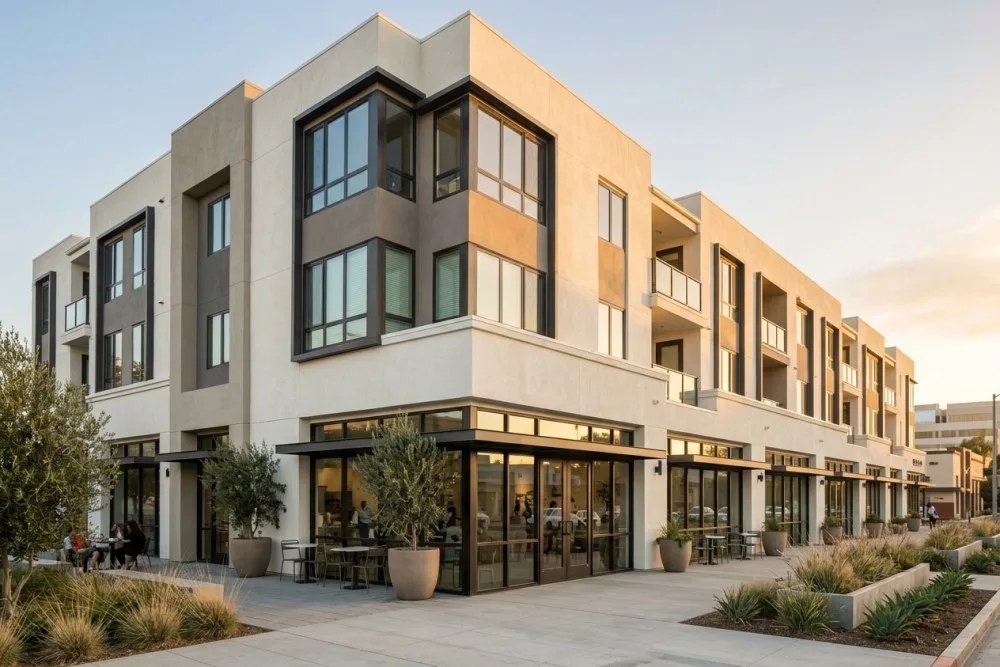
Orange County Implementation and Opportunities
Orange County jurisdictions have shown varying levels of preparedness for AB 2011 and SB 6 implementation. The vast majority of Bay Area jurisdictions were deferring planning to address AB 2011 until after the law was in effect, with only 16 out of 106 Bay Area jurisdictions addressing AB 2011 in their housing elements.
We're seeing more proactive engagement from Orange County cities, particularly those facing significant RHNA (Regional Housing Needs Allocation) requirements. Costa Mesa, Anaheim, and Santa Ana have begun updating their processes, while some smaller jurisdictions still lag in implementation.
Market-Specific Opportunities
Based on our market analysis and current office conditions:
Irvine: North Orange County experienced a 40bps decline in vacancy to 9.3% in Q2 2025, marking the tightest submarket in Orange County, but older office inventory still presents conversion opportunities.
Central Orange County: Central OC had the highest vacancy rate at 18.3%, up 20bps from 18.1% in Q1 2025, creating the strongest conversion fundamentals.
Costa Mesa: The city lacks rent control ordinances but has supportive development policies and excellent transit access along major corridors.
Financial Structuring and Investment Strategy
Successful conversion projects require careful financial structuring to maximize the benefits of streamlined approvals while managing labor cost premiums. We typically structure projects to achieve 15-20% IRR through a combination of acquisition discounts, construction savings, and accelerated lease-up.
Buying conversion candidates at a discount is paramount, particularly given current credit market conditions. Such financial wildcards don't take into account the tight-fisted credit environment at the moment.
Key financial advantages include:
- Reduced carrying costs: 18-24 month timeline reduction saves significant interest expense
- Lower development fees: Many jurisdictions charge reduced impact fees for conversions
- Tax credit opportunities: Projects may qualify for historic preservation or energy efficiency credits
- Faster cash flow: Earlier lease-up and stabilization compared to ground-up development
Financing Considerations
Most construction lenders now understand AB 2011 and SB 6 pathways, though some still require additional legal opinions on ministerial approval certainty. We recommend working with lenders experienced in California housing law compliance.
Permanent financing benefits from the affordable housing component, with many agencies offering favorable terms for mixed-income properties. The density bonus opportunities also enhance project economics by increasing revenue potential.
Implementation Roadmap for Developers
Successful Orange County conversion projects require a systematic approach to site selection, entitlement strategy, and project execution. Based on our experience with multiple conversion projects, we recommend this phased approach:
Phase 1: Portfolio Analysis and Site Selection (2-3 months)
- Conduct zoning compliance analysis for existing commercial properties
- Evaluate building condition and conversion feasibility
- Assess transit proximity and urban use requirements
- Perform preliminary financial modeling
Phase 2: Pre-Application and Strategy (1-2 months)
- Schedule pre-application meetings with local planning departments
- Confirm AB 2011 vs SB 6 pathway selection
- Engage architects experienced with conversion projects
- Begin labor compliance planning
Phase 3: Formal Application and Approval (6-10 months)
- Submit complete application packages
- Respond to consistency determination requests
- Obtain ministerial approvals and building permits
- Finalize construction financing
The key to success lies in thorough preparation and understanding of local implementation nuances. With the passage of AB 2243, we are seeing increased interest and greater optimism for expanded opportunities for housing in commercial areas using this law.
Future Outlook and Program Expansion
Both AB 2011 and SB 6 operate through January 1, 2033, providing an eight-year window for conversion projects. The California Department of Housing and Community Development will study the effects of AB 2011 and SB 6 in the coming years for a more comprehensive understanding of the advantages of mixed-use development in California.
The success of AB 2243 amendments suggests continued legislative support for conversion projects. While AB 3068 was vetoed due to concerns with labor standards compliance mechanisms, the Governor expressed "strong" support for "efforts to address California's housing crisis by promoting adaptive reuse projects".
For Orange County developers, the current environment represents an optimal entry point. Office vacancy remains elevated, construction costs favor conversion over new development, and the regulatory framework continues to evolve in favor of adaptive reuse projects.
We expect continued expansion of eligible sites and streamlined procedures as jurisdictions gain implementation experience. Early movers will benefit from the strongest site selection and optimal market timing as conversion activity accelerates across Orange County's commercial corridors.
Frequently Asked Questions