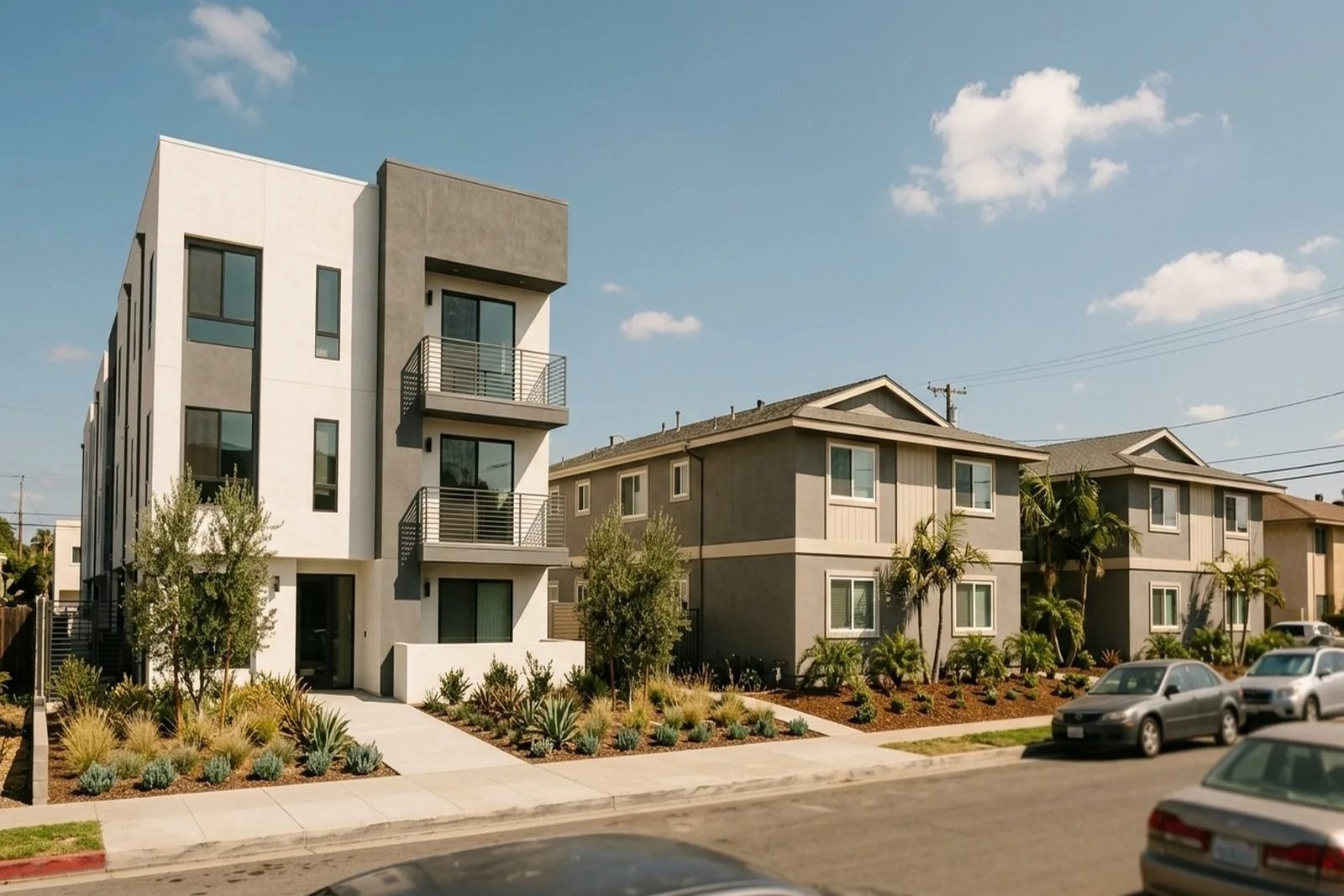
Ground-up development and value-add acquisition are the two primary active real estate strategies in Orange County. Both create value. Both require skill and capital. But they do so through fundamentally different mechanisms, with different risk profiles, timelines, and return expectations. Here’s the honest comparison — and how to decide which one fits where you are as an investor in 2026.
If you’re an active real estate investor in Orange County, you’ve heard the pitch for both strategies. Ground-up development: buy raw or underentitled land, navigate the entitlement process, build, and capture the development premium. Value-add acquisition: buy an underperforming existing asset, improve operations and/or renovate units, and capture the rent growth and NOI improvement.
We do both at NextGen Properties. They are not competing strategies — they serve different investor profiles and market conditions. Here’s how they actually compare.
Ground-up targets 20%+ IRR over 5 years, requires $5M+ equity, risk score 9/10. Value-add targets 12–18% IRR over 3 years, needs $1.5M minimum, risk score 5/10. Value-add typically offers better risk-adjusted returns for private investors.
How Each Strategy Creates Value
Ground-up development creates value through the development spread — the gap between what it costs to build a property and what that stabilized property is worth at prevailing cap rates. As we cover in our guide to evaluating development deals, a well-executed OC project might cost $400,000/unit to build and stabilize at a value equivalent to $550,000/unit — creating $150,000/unit in value through the construction and lease-up process. Value is created by building something that didn’t exist and wouldn’t exist without your effort.
Value-add acquisition creates value by improving an asset that exists but is underperforming. The sources of value creation: below-market rents that can be raised at turnover (within AB 1482 limits), deferred maintenance that suppresses NOI and therefore valuation, operational inefficiencies (high vacancy, high delinquency, poor vendor management), or mismanagement that a better operator can fix without major capital investment. Value is created by doing something better with an asset that already exists.
Return Comparison: IRR and Multiples
| Metric | Ground-Up Development | Value-Add Acquisition |
|---|---|---|
| Target IRR (OC, integrated operator) | 25–40%+ | 15–25% |
| Equity multiple (typical hold) | 2.0–3.5x over 4–6 years | 1.5–2.5x over 3–5 years |
| Cash-on-cash during hold | Typically negative during construction; improving post-stabilization | Often negative in OC (negative leverage); improving as NOI grows |
| Return driver | Development spread + appreciation | NOI improvement + appreciation + debt paydown |
The higher IRR potential in ground-up is real — but it comes with meaningfully higher risk and a longer timeline. A value-add deal that returns 20% IRR over 4 years is in many ways more attractive to sophisticated investors than a development deal targeting 35% IRR if the development deal carries 5x the execution risk.
Capital Requirements and Timing
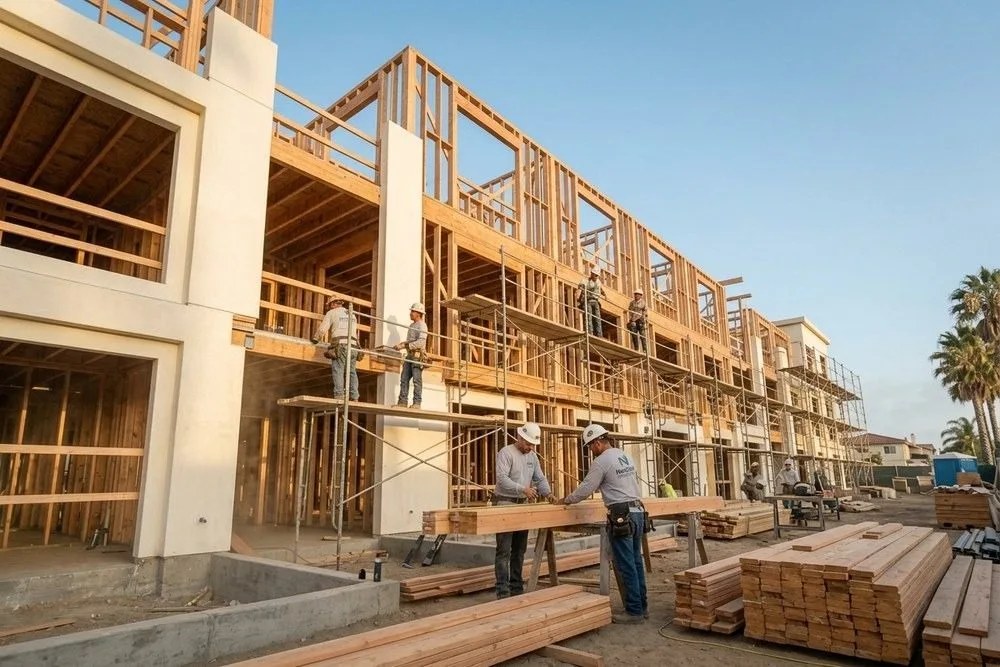
Ground-up development is capital-intensive over a long timeline. You need equity for the land acquisition, carrying costs during entitlement (which can take 2–5 years in OC), construction equity (typically 35–40% of total project cost for a construction loan), and operating reserves through lease-up. Capital is at risk for a long period before you see any return. Typical total equity commitment: $2,000,000–$5,000,000+ on a 20–30 unit OC infill project.
Value-add acquisition requires equity for the purchase (down payment plus closing costs), renovation capital (can be staged rather than front-loaded), and operating reserves during renovation and lease-up. Capital is deployed more quickly and begins generating returns sooner. Typical total equity commitment: $1,000,000–$3,000,000+ on a similarly sized OC acquisition.

Risk Profiles: Where Each Strategy Can Go Wrong
Ground-up development risks:
- Entitlement failure — CEQA challenge, political opposition, or project denial after years of investment
- Construction cost overruns — the most common value destroyer in development; OC has seen 20–40% cost increases in recent years
- Market timing — if cap rates expand significantly between project inception and completion, the development spread narrows or disappears
- Lease-up risk — slower absorption than projected extends the negative cash flow period
Value-add acquisition risks:
- Underwriting errors — missed operating expenses, particularly property taxes post-Prop 13 reassessment, insurance increases, or deferred capital items. See our full guide to OC multifamily underwriting.
- AB 1482 constraints — below-market rent upside is legally capped at 5% + CPI annually on existing tenants; value creation requires turnover, which takes time
- Renovation scope creep — deferred maintenance that wasn’t visible during due diligence surfaces after acquisition
- Negative leverage — in OC’s compressed cap rate environment, debt financing often destroys short-term cash flow rather than amplifying it
The OC Market Context in 2026
Both strategies face the same market headwinds in OC: elevated financing costs, compressed cap rates, and strong regulatory protections for existing tenants. But the headwinds hit differently:
For value-add, negative leverage at 4.2% cap rates means you’re buying negative cash flow in year one and betting on NOI growth and appreciation. That bet is well-supported by OC’s structural supply constraints, but it requires patient capital and strong operational execution.
For ground-up, the development spread in OC remains attractive if you can execute on entitlement and construction. The supply cliff approaching in 2027–2028 — with only 4,775 units currently under construction countywide — means projects completing in that window face less competitive lease-up pressure. The entitlement risk and construction cost risk are the primary concerns.

Which Strategy Fits Your Situation?
Ground-up development fits you if:
- You have patient capital willing to be committed for 4–7 years without interim distributions
- You have (or can access) entitlement expertise — or you’re investing alongside an operator who does
- You can tolerate years of negative cash flow during construction and lease-up
- You have access to deal flow — entitled sites in OC don’t come to market easily
- Your return target is 25%+ IRR and you’re willing to take the execution risk to get there
Value-add acquisition fits you if:
- You want to see tangible asset performance sooner than development allows
- You want to deploy capital into an asset that already exists and generates income (even if negative carry in year one)
- Your return target is 15–22% IRR with lower execution risk than ground-up
- You have access to strong operational management to capture the NOI improvement
- You want to participate in OC’s long-term appreciation story without taking entitlement or construction risk
The Case for Both: NextGen’s Integrated Approach
The reason we pursue both strategies at NextGen Properties isn’t that we can’t choose — it’s that the two strategies complement each other within a portfolio. Development deals generate higher IRR but tie up capital for longer. Value-add deals generate steadier cash flow and shorter hold periods. Across a portfolio that holds both, the overall risk-adjusted return is better than concentrating all capital in either strategy alone.
Our integrated platform — acquisition, development, construction, and management under one roof — is also what makes us competitive in both strategies simultaneously. Our management team’s real market data informs our development underwriting. Our construction team executes value-add renovations at cost. Our acquisition team sources both stabilized assets for value-add and raw land for development from the same OC broker network. That integration is the advantage that drives our 25%+ average IRR across both strategy types.
Frequently Asked Questions