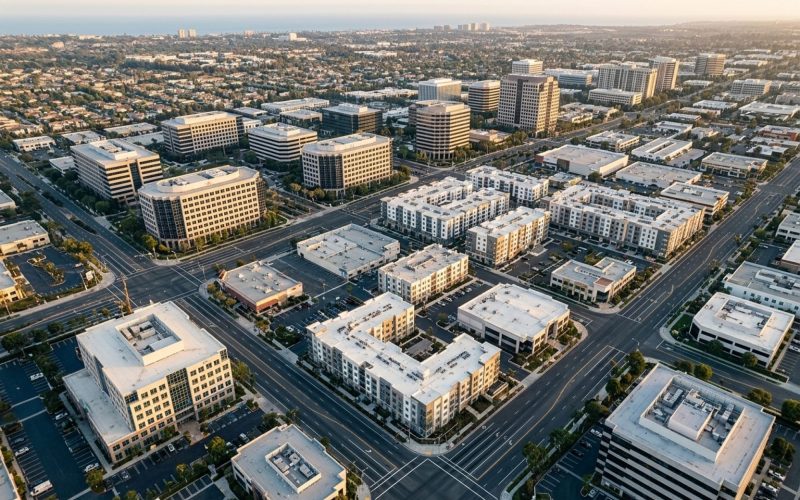
SB 79 fundamentally transforms Orange County development starting July 2026, allowing up to 95-foot building heights and 160 units per acre within proximity zones of transit stops. After 25 years managing Orange County developments, we've seen legislative changes reshape markets, but SB 79 represents the most significant shift since the Density Bonus Law. The legislation creates three distinct proximity tiers around OCTA bus stops, Metrolink stations, and future light rail, each with specific height and density allowances that override local zoning restrictions. For developers, this opens immediate opportunities on previously constrained sites, but success requires understanding complex compliance requirements, community benefit provisions, and the interaction with existing laws like SB 9 and local overlay districts.
Understanding SB 79: The Fundamentals
Senate Bill 79 represents California''s most aggressive transit-oriented development legislation to date, taking effect July 1, 2026. The law preempts local zoning within defined proximity zones of transit infrastructure, allowing significantly increased heights and densities that many Orange County cities have historically resisted.
Unlike previous housing laws that provided modest density bonuses, SB 79 establishes absolute development rights. Properties meeting proximity and compliance requirements can build to the new standards regardless of local general plans or community opposition. In our portfolio, we''re already seeing investors target sites within the proximity zones, anticipating the dramatic increase in development potential.
The law applies to both residential and mixed-use projects, but requires specific affordability components and community benefits that vary by proximity tier. Understanding these requirements early in the due diligence process is crucial for accurate project underwriting.
Proximity Zones and Tier Classifications
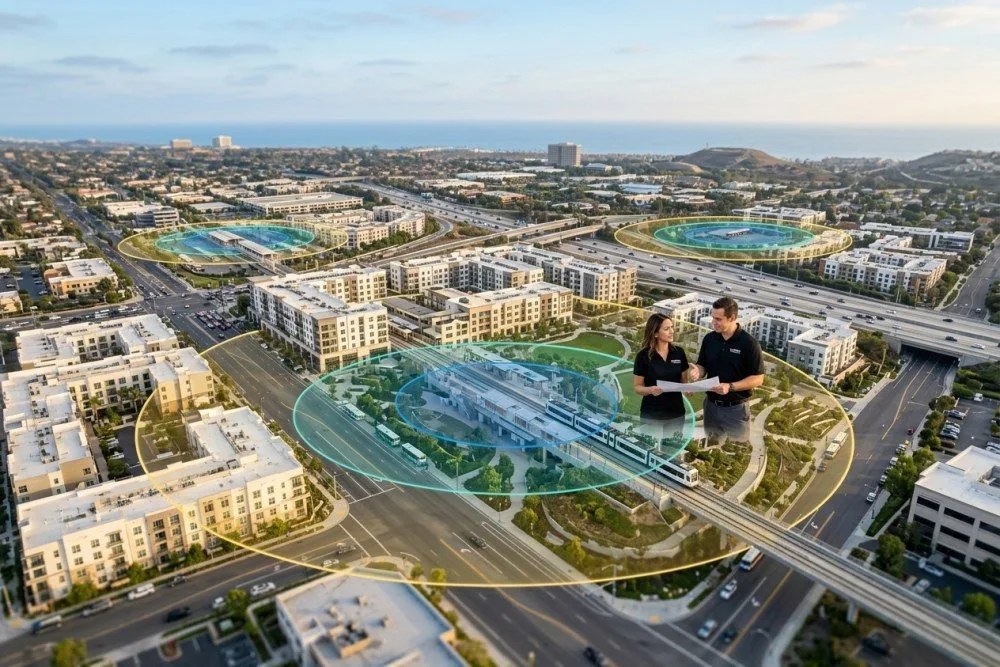
SB 79 establishes proximity zones based on distance from qualified transit stops, with two stop tiers (Tier 1 for heavy rail and very-high-frequency commuter rail, Tier 2 for light rail and qualifying rapid bus). Qualifying projects within one-quarter mile of a stop — and up to one-half mile in cities over 35,000 — can build up to 95 feet and 160 units per acre, with adjacency intensifiers adding 20 feet and 40 du/ac. In Orange County, this includes OCTA bus rapid transit stops, Metrolink stations, and planned light rail stations under the OC Streetcar and future expansions.
Tier 1: High-Frequency Transit (0-660 feet)
Properties within 660 feet of high-frequency transit stops qualify for maximum development rights: 95-foot height limits and 160 units per acre. High-frequency transit includes OCTA bus lines with 15-minute or better headways during peak hours and all Metrolink stations.
Key Orange County Tier 1 locations include areas around the Anaheim Regional Transportation Intermodal Center, Santa Ana Regional Transportation Center, and major bus rapid transit corridors along Beach Boulevard, Harbor Boulevard, and Bristol Street. These zones offer the highest development potential. Projects over 10 units must dedicate 7% of units to extremely low income, 10% to very low income, or 13% to lower income households, with deed restrictions lasting 55 years for rentals and 45 years for ownership units.
Tier 2: Standard Transit (661-1,320 feet)
The second tier extends from 661 to 1,320 feet from qualified transit, allowing 75-foot heights and 120 units per acre. This tier captures significantly more developable land throughout Orange County while still providing substantial density increases over existing zoning.
Tier 2 zones encompass much of central Anaheim, Santa Ana, and portions of Costa Mesa, Irvine, and Fullerton near transit corridors. The same affordability thresholds apply across all qualifying zones — 7%, 10%, or 13% depending on the income targeting level chosen by the developer.
Tier 3: Transit-Adjacent (1,321-2,640 feet)
Properties between 1,321 and 2,640 feet from transit qualify for 55-foot heights and 80 units per acre. While more modest than inner tiers, these standards still exceed most existing Orange County zoning, particularly in historically low-density areas.
Tier 3 captures suburban areas of Anaheim, Santa Ana, and parts of Garden Grove, Orange, and Tustin. The affordability requirements are consistent across all zones, making project economics more predictable for developers entering the transit-oriented market.
Development rights decrease with distance from transit, but all tiers exceed typical OC zoning limits.
| Proximity Zone | Max Height | Max Density | Affordability Req. |
|---|---|---|---|
| Adjacent to stop (intensifier) | 115 feet | 200 units/acre | 7 / 10 / 13% |
| Within 1/4 mile of stop | 95 feet | 160 units/acre | 7 / 10 / 13% |
| 1/4 to 1/2 mile (cities >35K) | 95 feet | 160 units/acre | 7 / 10 / 13% |
Orange County Transit Infrastructure Coverage
Understanding Orange County''s existing and planned transit infrastructure is crucial for identifying SB 79 opportunities. The county''s transit network includes multiple systems that qualify for proximity zone calculations under the new law.
OCTA bus rapid transit forms the backbone of qualifying transit, with key corridors along major arterials. The system includes dedicated bus rapid transit lanes on select routes and high-frequency service that meets SB 79''s qualification standards during peak hours.
Metrolink provides regional rail service with stations in Anaheim, Santa Ana, Irvine, San Juan Capistrano, and other locations. These stations anchor some of Orange County''s highest-value Tier 1 development zones, given their regional connectivity and existing transit-oriented planning.
The OC Streetcar, connecting Santa Ana and Garden Grove, represents Orange County''s first modern light rail line. When operational, it will create new Tier 1 zones along its 4.15-mile route, opening development opportunities in areas previously limited by local zoning.
Planned Expansions
SB 79 includes provisions for planned transit infrastructure, allowing developers to utilize proximity zone benefits for projects near funded transit expansions. OCTA''s long-term plans include additional bus rapid transit corridors and potential light rail extensions that could qualify under these provisions.
The West Santa Ana Branch Transit Corridor, extending from Los Angeles into Orange County, represents the largest planned expansion affecting SB 79 zones. Properties along the planned route may qualify for development rights based on projected completion timelines and funding commitments.

Compliance Requirements and Community Benefits
SB 79 development rights come with specific compliance requirements that developers must meet throughout the entitlement and construction process. These requirements go beyond simple affordability percentages, encompassing design standards, community benefits, and ongoing compliance monitoring.
Affordability compliance requires long-term deed restrictions — 55 years for rental properties and 45 years for ownership units. Units must be affordable to extremely low, very low, or lower income households depending on the percentage option the developer selects (7%, 10%, or 13% of total units respectively).
Design standards under SB 79 emphasize transit connectivity, requiring pedestrian and bicycle infrastructure connecting projects to transit stops. Ground-floor commercial space is encouraged in Tier 1 zones, though not explicitly required in all cases.
Community benefit requirements vary by jurisdiction but often include contributions to affordable housing funds, public space improvements, or infrastructure upgrades. Cities retain some discretion in structuring these benefits, creating opportunities for negotiation during the entitlement process.
Environmental Review Streamlining
Projects utilizing SB 79 benefits qualify for streamlined environmental review under CEQA, similar to other recent housing legislation. This can significantly reduce entitlement timelines, though projects must still meet standard environmental standards and mitigation requirements.
The streamlining provisions are particularly valuable in Orange County, where CEQA challenges have historically delayed development projects. However, developers should budget for thorough environmental analysis upfront to avoid delays during the streamlined review process.
Development Economics Under SB 79
SB 79''s increased height and density allowances fundamentally alter development economics in Orange County, where high land costs have historically made many projects infeasible. The ability to build 95-foot, 160-unit-per-acre projects transforms the financial analysis for sites near transit.
In our experience with Orange County development projects, land basis typically represents 25-30% of total project costs. SB 79''s density increases can double or triple the supportable land value for qualifying sites, creating immediate equity for existing landowners and new acquisition opportunities for developers.
However, the affordability requirements and community benefits reduce effective project revenues. Our analysis suggests Tier 1 projects need to achieve market rents of $3.25-$3.50 per square foot to support development costs including the affordability component and required benefits.
Construction costs increase with height, but the economies of scale from higher density often offset these increases. Projects in the 75-95 foot range can utilize efficient podium-style construction while achieving the unit counts necessary to support Orange County''s high development costs.
Higher density tiers generate better returns despite increased affordability requirements in Costa Mesa property management markets.
| Development Type | Units/Acre | Avg. Unit Size | Return on Cost |
|---|---|---|---|
| SB 79 Adjacent (intensifier) | 200 | 700 sq ft | 18.5% |
| SB 79 Within 1/4 Mile | 160 | 750 sq ft | 16.8% |
| SB 79 1/4-1/2 Mile | 160 | 800 sq ft | 15.5% |
| Conventional Zoning | 35 | 1,100 sq ft | 11.4% |
Financing Considerations
SB 79 projects require sophisticated financing given their size, complexity, and affordability components. Construction loans typically need 25-30% developer equity, with permanent financing structured to accommodate the deed-restricted affordable units.
Tax credit equity from Low-Income Housing Tax Credits can help finance the affordability component, though moderate-income targeting limits the available credits compared to deeper affordability projects. Many SB 79 projects will require creative financing structures combining conventional debt, tax credits, and potentially public gap financing.
Orange County''s high market rents support the debt service on larger projects, but developers need to carefully underwrite absorption rates for the increased unit counts. Projects delivering 200-400 units simultaneously require different marketing and lease-up strategies than conventional 50-100 unit developments.
Site Identification and Due Diligence
Identifying optimal SB 79 sites requires analyzing proximity to transit, existing zoning constraints, and development feasibility factors specific to Orange County''s market conditions. The most valuable opportunities often exist where SB 79 provides the greatest increase over existing development rights.
Transit proximity verification requires precise measurement from property boundaries to transit infrastructure, using the specific measurement methodologies outlined in the legislation. Properties just outside proximity zones won''t qualify, making accurate surveying crucial during initial site evaluation.
Existing zoning analysis helps identify sites where SB 79 provides maximum uplift. Properties currently zoned for low-density residential or commercial use see the greatest benefit, while sites already zoned for high-density development may see more modest improvements.
Site constraints including topography, utilities, and environmental conditions become more critical given the increased development intensity. Properties that can accommodate 160 units per acre with structured parking and required amenities are limited, creating premium valuations for well-positioned sites.
Market Analysis Factors
Orange County''s varied submarkets respond differently to high-density development, making location-specific market analysis crucial for SB 79 projects. Areas with established multifamily markets and strong transit usage patterns typically support the higher densities more effectively.
Rental rate analysis must account for the unit mix changes that higher density development typically requires. SB 79 projects tend toward smaller unit sizes to maximize density, requiring different rent per square foot assumptions than conventional developments.
Competition analysis becomes more complex given the potential for multiple SB 79 projects in transit corridors. Developers need to consider the cumulative impact of increased development rights on local market absorption and pricing power.

Entitlement Process and Timeline
SB 79 significantly streamlines the entitlement process compared to conventional Orange County development, though projects still require careful navigation of local review procedures and community engagement. The law''s ministerial approval provisions reduce discretionary review, but thorough preparation remains essential.
Pre-application preparation should include comprehensive site analysis, preliminary design development, and early coordination with city planning staff. While SB 79 limits cities'' ability to deny qualifying projects, early collaboration helps identify potential issues and streamline the formal review process.
Environmental review under CEQA streamlining provisions typically takes 60-90 days for SB 79 projects, compared to 12-18 months for conventional high-density developments in Orange County. However, projects must provide complete environmental analysis upfront, requiring significant investment before approval certainty.
Design review remains part of the process, though cities cannot use design standards to effectively deny projects or reduce density below SB 79 minimums. Successful projects balance community design preferences with cost-effective construction and the density requirements that make projects financially feasible.
Community Engagement Strategy
Despite SB 79''s ministerial approval provisions, effective community engagement remains valuable for project success and ongoing community relations. Opposition can create delays even within the streamlined process, making proactive outreach important.
Successful engagement focuses on the transit-oriented benefits, including reduced parking demand, walkable design, and community-serving ground-floor commercial space. Emphasizing the moderate-income affordability component can help build support among workforce housing advocates.
Working with local business associations and transit advocacy groups can provide community support during the entitlement process. These stakeholders often understand the benefits of increased density near transit and can serve as project advocates during public review processes.
Integration with Existing Housing Laws
SB 79 operates alongside California''s existing housing legislation, creating opportunities for developers to combine multiple laws for maximum development potential. Understanding how SB 79 interacts with SB 9, SB 1211, and local density bonus programs is crucial for optimizing project economics.
SB 9 interaction allows lot splitting combined with SB 79 development rights in some cases, though the practical application depends on lot size and configuration. Properties large enough to accommodate SB 79 densities rarely benefit from SB 9''s lot splitting provisions, but smaller sites might utilize both laws strategically.
Local density bonus programs may provide additional development rights beyond SB 79 minimums, particularly for projects providing deeper affordability or other community benefits. Orange County cities retain the ability to offer additional incentives, creating opportunities for projects exceeding SB 79''s baseline requirements.
The relationship with SB 1211 multifamily ADU provisions allows SB 79 projects to add detached accessory dwelling units, further increasing density potential. A 100-unit SB 79 project could theoretically add up to eight ADUs under SB 1211, though site constraints often limit practical application.
Regulatory Coordination
Projects utilizing multiple housing laws require careful coordination to ensure compliance with all applicable requirements. Affordability obligations, design standards, and ongoing monitoring requirements can overlap or conflict, requiring legal analysis and structured compliance planning.
Financing structures become more complex when combining multiple laws, as different provisions may have varying affordability targeting, deed restriction periods, and compliance monitoring requirements. Lenders and equity partners need clear documentation of all applicable legal requirements.
The potential for regulatory changes affecting any of the underlying laws creates additional due diligence requirements. Projects with long development timelines need to consider the risk of legislative modifications affecting project economics or compliance requirements.
Implementation Strategies for Developers
Successfully implementing SB 79 development projects requires strategic planning that addresses Orange County''s unique market conditions, regulatory environment, and community dynamics. Developers entering this market need comprehensive strategies covering site acquisition, project planning, and long-term asset management.
Site acquisition strategy should focus on areas where SB 79 provides maximum development rights increases while maintaining strong fundamentals for long-term investment performance. Properties in established neighborhoods with existing multifamily acceptance often provide better community reception than sites in historically single-family areas.
Phased development approaches can help manage risk and market absorption for larger sites capable of supporting multiple SB 79 projects. Breaking 400-unit developments into two phases allows developers to adjust design, pricing, and marketing based on initial phase performance.
Partnership strategies with experienced Orange County developers can provide local market knowledge and community relationships valuable for SB 79 project success. Many smaller developers have site control but lack the capacity for high-density projects, creating joint venture opportunities.
Long-term Asset Management
SB 79 projects require sophisticated Orange County property management given their size, density, and affordability compliance requirements. Traditional property management approaches may not scale effectively to 200-400 unit projects with mixed-income tenant populations.
Technology integration becomes crucial for efficient operations at higher densities, including automated rent collection, maintenance request systems, and compliance monitoring for affordable units. Properties with 15% affordability requirements need systems to track income certifications and unit availability.
Community programming and amenity management take on greater importance in high-density projects where residents share more common spaces and facilities. Successful SB 79 properties often include dedicated community programming staff and enhanced amenity offerings to support resident satisfaction and retention.

Risks and Mitigation Strategies
SB 79 development projects carry specific risks that developers must identify and mitigate throughout the development process. Understanding these risks and implementing appropriate mitigation strategies is crucial for successful project completion and long-term performance.
Regulatory risk includes potential legislative modifications to SB 79 or related housing laws that could affect project economics or compliance requirements. While the law includes sunset provisions protecting projects in the entitlement pipeline, developers should structure deals with flexibility for regulatory changes.
Market absorption risk increases with the higher unit counts that SB 79 enables. Orange County''s historically strong rental markets may not immediately absorb 200-400 unit project deliveries, particularly if multiple SB 79 projects deliver simultaneously in the same submarket.
Construction cost escalation poses greater risks for larger projects given their extended construction timelines and higher total costs. Fixed-price construction contracts with appropriate contingencies help mitigate this risk, though contractors may require higher pricing for cost certainty on complex projects.
Financial Risk Management
Financing risk increases with project size and complexity, particularly given the relatively untested nature of SB 79 projects in Orange County''s market. Securing construction financing before significant pre-development investment helps ensure project viability.
Interest rate risk affects larger projects more significantly given their higher leverage and longer development timelines. Rate hedging strategies or variable-to-fixed rate conversion options can help manage this exposure, though at additional cost.
Lease-up risk requires careful market analysis and potentially phased delivery approaches to manage absorption. Projects should budget for extended lease-up periods and potentially higher concession packages to achieve stabilized occupancy in competitive markets.
The affordability compliance requirements create ongoing operational risks that developers must price into long-term returns. Violations can result in significant penalties and potentially jeopardize project financing, making robust compliance systems essential from project inception.
Frequently Asked Questions