California Senate Bill 9 has been law since January 2022 ? but four years later, most Orange County developers and investors are still leaving SB 9 opportunities on the table. The law allows ministerial approval for lot splits and duplexes on single-family parcels statewide, bypassing discretionary review in most cases. In a county where entitled multifamily land is nearly impossible to find, SB 9 represents a real development pathway ? if you know which parcels qualify, which cities are genuinely compliant, and how to underwrite the projects correctly.
What SB 9 Actually Does
California Senate Bill 9, signed by Governor Newsom in September 2021 and effective January 1, 2022, creates two distinct ministerial approval pathways on single-family residential parcels across California.
The first pathway is a lot split: eligible single-family parcels can be divided into two lots, each at least 1,200 square feet, without a conditional use permit, variance, or discretionary planning approval. The split must create roughly equal halves — neither resulting lot can be less than 40% of the original parcel area.
The second pathway is a duplex by right: a property owner can build a duplex on any single-family zoned lot, again without discretionary review. Combined, these two pathways theoretically allow a single-family parcel to host up to four units — two duplexes on two split lots — plus any existing ADU rights under California Government Code Section 65852.2.
Ministerial approval means the city cannot impose design review, neighborhood compatibility findings, or other discretionary conditions. They can only apply objective development standards — setbacks, height limits, floor-area ratios — that are uniformly applied and not specifically designed to impede SB 9 projects. This is the most powerful feature of the law, and also the one that cities have pushed back on most aggressively.
OC City Compliance Status
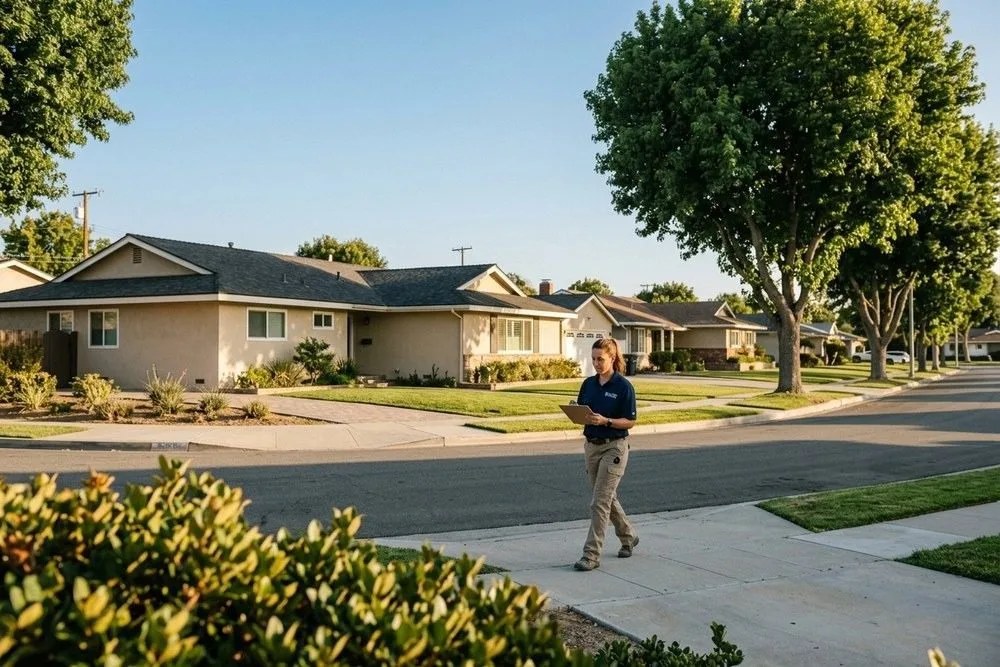
State law is clear that all California cities must comply with SB 9. What varies is how cities have implemented their objective development standards — and whether those standards are genuinely neutral or are designed to make SB 9 projects infeasible. As of early 2026, OC cities broadly fall into three categories.
Generally compliant and workable: Anaheim, Santa Ana, Garden Grove, Stanton, and Buena Park have implemented SB 9 standards that, while not enthusiastic, do not appear designed to block projects. Minimum lot sizes, setbacks, and owner-occupancy requirements in these cities are consistent with what a developer can realistically build.
Technically compliant but restrictive: Irvine, Costa Mesa, Newport Beach, Huntington Beach, and Laguna Niguel have adopted objective standards with requirements — particularly around lot coverage, setbacks, and owner-occupancy affidavits — that significantly constrain feasibility. Newport Beach requires the applicant to sign an owner-occupancy covenant for three years, restricting the pure investor-developer play without a longer hold strategy.
High litigation risk or still contested: Several OC charter cities initially claimed SB 9 did not apply to them under the state-charter exemption doctrine. The California Supreme Court resolved this in 2024, confirming SB 9 applies to all cities including charter cities. However, implementation quality in some cities remains contested, and developers should obtain city-specific legal review before committing to a site.
Identifying Eligible Parcels
Not every OC single-family parcel qualifies for SB 9. The statute contains several mandatory exclusions that eliminate a meaningful portion of the theoretical opportunity.
Historic district exclusion: Parcels located within a historic district or on the State Historic Resources Inventory are ineligible. Several OC neighborhoods, particularly in Orange Old Towne and parts of Fullerton, carry historic overlay designations that would disqualify SB 9 use.
High fire hazard severity zones: Parcels in state-designated High or Very High Fire Hazard Severity Zones are excluded. In OC, this primarily affects portions of Laguna Beach, the Santa Ana Mountains interface communities, and some hillside areas in south county.
Hazardous waste or flood zone sites: Parcels within a delineated floodplain or a hazardous waste site are excluded.
Beyond the exclusions, developers should screen for minimum lot size after split (1,200 square feet per resulting lot), access — both lots must have either street frontage or a recorded access easement — and utility serviceability. A preliminary site analysis using the specific city’s adopted SB 9 ordinance is essential before any serious underwriting.
Underwriting an SB 9 Project
SB 9 development in OC is not a volume play — it is a targeted strategy that works on specific parcel types in specific submarkets. The underwriting logic differs from traditional multifamily in several important ways.
A well-underwritten SB 9 project using modular construction can total approximately $1.6M in North OC. Land acquisition basis is the single largest feasibility lever.
| Cost Component | Amount |
|---|---|
| Land Acquisition | $650,000 |
| Hard Construction (modular, 4 units) | $768,000 |
| Soft Costs (15%) | $115,000 |
| City Fees & Utility Connections | $60,000 |
| Financing & Carry | $45,000 |
| Total Project Cost | $1,638,000 |
Land acquisition basis matters more than usual. The economics of a two-lot, four-unit SB 9 project depend heavily on what you paid for the underlying single-family parcel. In coastal OC, SB 9 feasibility is often marginal unless the original acquisition was below market. In north and central OC — Anaheim, Stanton, Buena Park, Santa Ana — land values are low enough that the SB 9 math frequently works.
Use the ADU stack. SB 9 lot splits do not eliminate ADU rights. On each resulting lot, the property can still support one ADU and one junior ADU under Government Code Section 65852.2. A well-structured SB 9 project can therefore deliver up to six units on a single original parcel: two primary units per duplex per lot, plus four ADUs. This dramatically improves project economics and is the approach sophisticated OC developers are using.
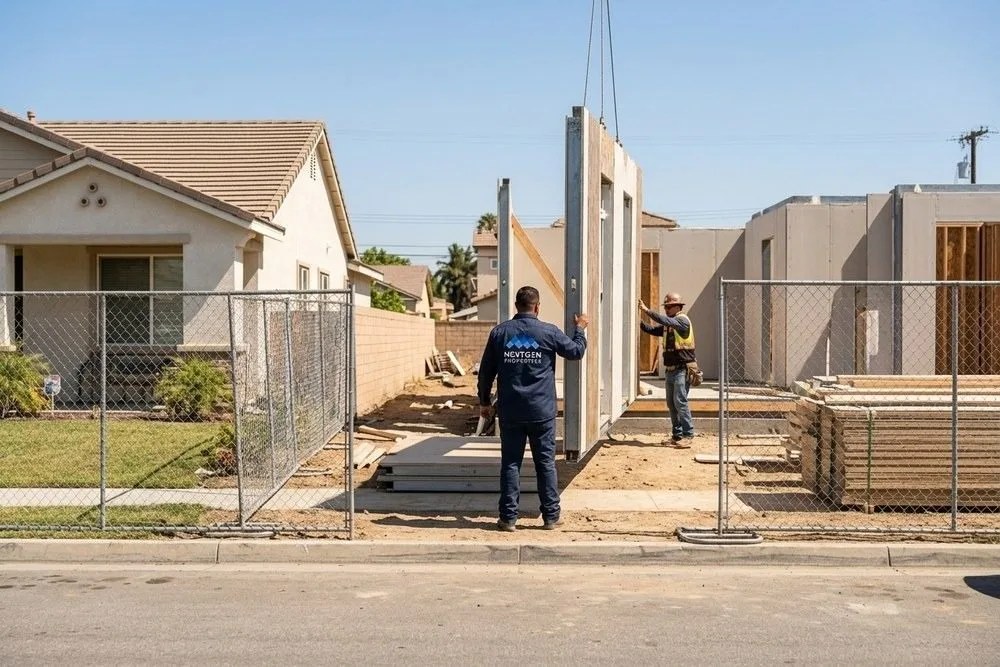
Construction cost discipline is critical. SB 9 units are small by nature — the duplex and ADU units that pencil best in this context are 600–1,100 square feet. Stick-frame construction at current OC labor and material costs runs approximately $280–$340 per square foot. Modular or panelized construction can reduce this to $220–$260 per square foot and shorten construction timelines, which matters for carry cost on a sub-$2M project.
Exit strategy determines structure. The three primary exits are: hold as rental income; condo conversion and retail sale of individual units — often the highest-value exit in coastal cities; and wholesale of the split lots to homebuilders. The condo conversion exit in coastal submarkets typically generates the highest total return but requires longer hold periods and HOA formation.
Challenges and Limitations
Owner-occupancy requirements. State law allows cities to require that the applicant owner-occupy one of the resulting units for three years as a condition of SB 9 lot split approval. Most OC cities have adopted this provision. For pure investor-developer strategies, this creates a structural impediment unless the developer is willing to designate a principal as the occupant or structure a longer-term hold before sale.
Design and setback constraints. Even where cities cannot impose discretionary review, objective standards can effectively limit what is buildable. Some OC cities require 4-foot side setbacks, 5-foot rear setbacks, and maximum 40% lot coverage — parameters that, applied to a 6,000-square-foot split lot, leave limited room for a second unit. Thorough pre-application meetings with city planning staff are worth the time investment before any site commitment.
Utility connections. Adding three to five units to a parcel designed for one creates real infrastructure demands. Water and sewer capacity, electrical panel upgrades, and separate metering requirements can add $40,000–$80,000 per project in connection and upgrade fees in some OC jurisdictions. This needs to be modeled from day one.
Neighbor opposition. While SB 9 eliminates discretionary review, neighbors can still file complaints and attempt to create administrative delay. Projects that minimize visible change to street-facing facades and maintain neighbor communication tend to move through the ministerial process faster — even where the law is clearly on the developer’s side.
Strategic Outlook for OC Developers
Four years into SB 9, the law has underperformed its theoretical potential statewide — the California Department of Housing and Community Development estimated in 2024 that fewer than 3,000 SB 9 projects had reached the permitting stage across the entire state. In Orange County specifically, uptake has been concentrated among a handful of experienced developers who have built repeatable processes around site selection, city-specific ordinance interpretation, and modular construction.
The opportunity for 2026 and beyond is real, but it favors operators with several characteristics: the ability to acquire single-family parcels at or below $700,000 in target submarkets; construction relationships that can deliver modular or panelized duplex units at sub-$260 per square foot; familiarity with the specific objective standards in target cities; and patience to navigate owner-occupancy requirements through either principal occupancy or structured hold periods.
NextGen Properties is actively tracking SB 9 opportunities across our primary OC submarkets — Costa Mesa, Anaheim, and Santa Ana — and will continue to evaluate sites where the acquisition basis, city standards, and construction economics align. For investors interested in participating in OC infill development, SB 9 is one of the few remaining pathways to create new multifamily value in an otherwise supply-constrained market.
Frequently Asked Questions