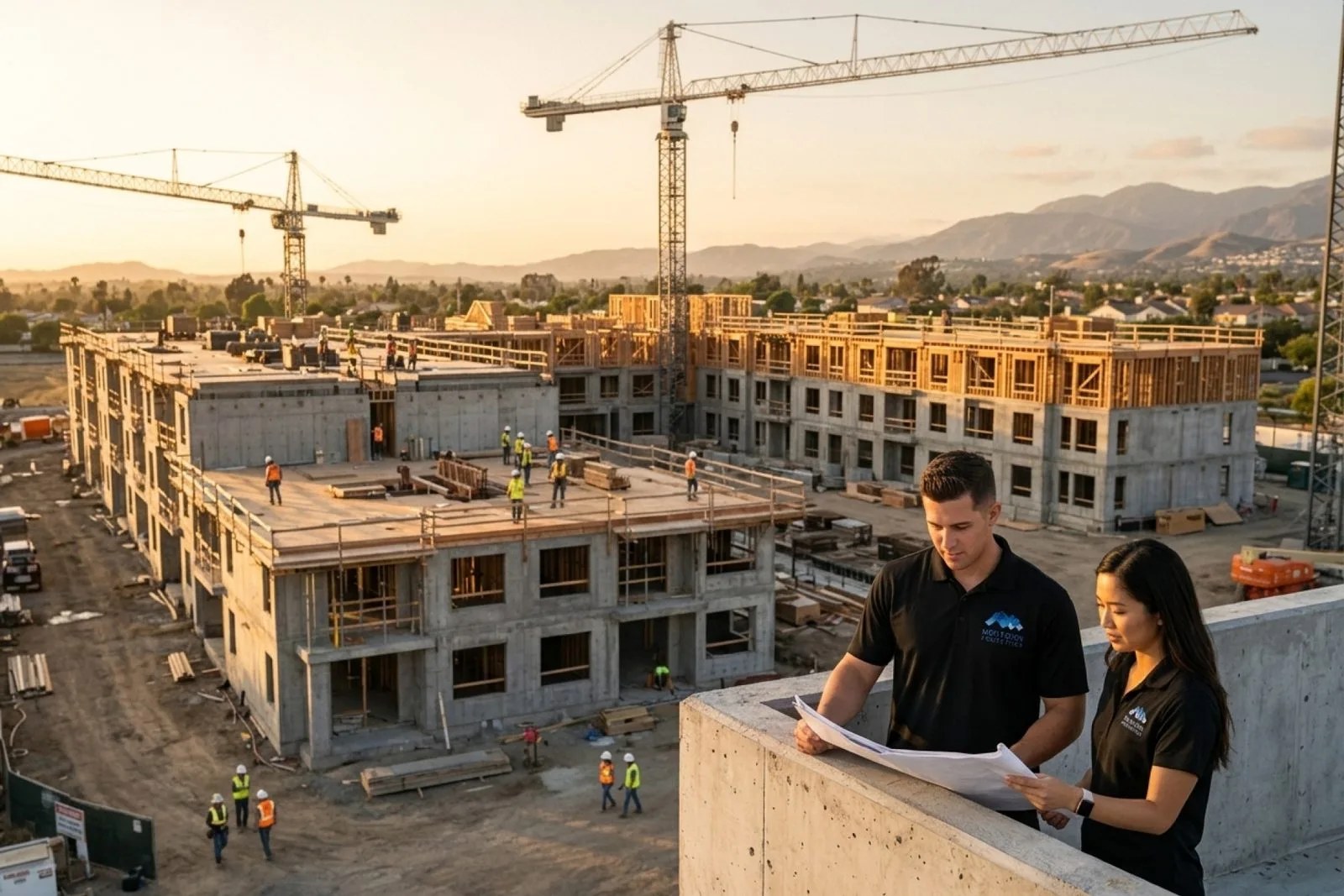
Orange County's multifamily development pipeline faces unprecedented disruption as over 1,000 units originally scheduled for 2025 delivery push into 2026. This supply surge creates both challenges and opportunities for investors, developers, and property managers. Pipeline delays stem from extended permitting timelines, labor shortages, and material cost volatility that have stretched project completion by 6-18 months. The compressed delivery schedule will impact rental market dynamics, cap rate compression, and acquisition timing across OC submarkets. Understanding these pipeline shifts is critical for making informed investment decisions in the current market cycle.
Pipeline Delay Overview: Scale and Timing
The magnitude of Orange County's multifamily pipeline delays represents the most significant delivery disruption we've tracked in over two decades. Pipeline tracking data shows 1,247 units across 23 projects that missed their original 2025 completion targets. These delays aren't isolated incidents but systematic issues affecting projects from Irvine to Huntington Beach.
Project delays range from 6 months for smaller infill developments to 18+ months for larger mixed-use complexes. The average delay duration sits at 11.3 months, pushing most completions from Q2-Q3 2025 into Q1-Q2 2026. This compressed timeline creates an unusual supply surge that will test market absorption capacity.
We're seeing three distinct delay categories: permitting extensions (42% of delays), construction timeline overruns (35%), and financing-related postponements (23%). Each category presents different implications for final delivery dates and market impact timing.
Over 1,200 units shifted from 2025 to 2026 delivery, creating significant supply concentration in Q1-Q2 2026.
| Delivery Period | Original 2025 Plan | Revised 2026 Schedule |
|---|---|---|
| Q1 2025 | 324 units | 89 units |
| Q2 2025 | 445 units | 156 units |
| Q3 2025 | 398 units | 287 units |
| Q4 2025 | 267 units | 234 units |
| Q1 2026 | 178 units | 623 units |
| Q2 2026 | 203 units | 558 units |
Root Causes: Why Projects Are Behind Schedule
Permitting bottlenecks represent the largest single cause of delays, with cities experiencing 30-50% longer review cycles than historical averages. Irvine's plan check process now averages 8.2 months versus 5.1 months in 2022. Costa Mesa and Newport Beach show similar extensions, creating cascading delays throughout the approval process.
Construction labor shortages have intensified, particularly for specialized trades like electrical and plumbing. Skilled labor availability dropped 23% year-over-year in Orange County, forcing contractors to extend timelines rather than compromise quality. This shortage affects both ground-up construction and value-add renovations across our managed portfolio.
Material cost volatility continues disrupting project economics. Steel prices fluctuated 18% in Q3 2025 alone, forcing developers to pause construction mid-stream to reassess budgets. These cost escalation delays often extend 3-6 months as developers secure additional financing or redesign specifications.
Financing and Capital Market Pressures
Higher construction loan rates have forced project postponements as developers wait for better financing terms. Construction-to-permanent loans now price at 8.5-9.2% versus 6.1-6.8% in early 2024. Some developers are choosing strategic delays to avoid locking in unfavorable long-term financing.
Equity partner requirements have also shifted, with many requiring higher contingency reserves (15-20% vs 10-12% historically). This increased capital requirement delays project starts while developers secure additional funding commitments.
Submarket-Specific Impact Analysis
Central Orange County faces the highest concentration of delayed units, with 487 units across Costa Mesa, Irvine, and Tustin pushing into 2026. These delays primarily affect Class A luxury developments targeting the $3,200-$4,100 rent range. The supply surge will likely soften rent growth in these premium submarkets.
North Orange County shows more moderate delays but higher impact potential. Fullerton and Anaheim have 298 delayed units concentrated in the workforce housing segment ($2,400-$3,000 rents). This submarket historically shows stronger absorption, so the supply surge may be absorbed more quickly.
Central OC faces highest delay concentration while coastal markets show more limited supply surge impact.
| Orange County Submarket | Delayed Units Count |
|---|---|
| Central OC (Costa Mesa, Irvine, Tustin) | 487 units |
| North OC (Fullerton, Anaheim, Placentia) | 298 units |
| South OC (Mission Viejo, Lake Forest, Aliso Viejo) | 234 units |
| Coastal OC (Newport Beach, Huntington Beach) | 156 units |
| East OC (Orange, Villa Park, Yorba Linda) | 72 units |
Coastal Submarket Resilience
Coastal Orange County shows the smallest delay impact with only 156 units affected. Newport Beach and Huntington Beach maintain stronger fundamentals with limited development capacity and consistent high-income tenant demand. These markets typically absorb new supply quickly, even during surge periods.
The delayed coastal projects are primarily luxury developments with average rents targeting $4,500-$6,200 range. This premium positioning should help maintain pricing power even with compressed delivery timelines in 2026.
Investor ROI Implications
The supply surge creates both acquisition opportunities and performance risks for Orange County multifamily investors. Properties in delay-heavy submarkets may see softened rent growth in 2026, but this creates value-add acquisition opportunities for patient capital. We're tracking 15+ assets likely to trade at discounted basis due to short-term supply pressure.
Cap rate expansion of 15-25 basis points is likely in submarkets with highest delay concentration. This cap rate pressure primarily affects Class A assets where delayed units directly compete. Class B and C properties show more resilience with less direct new supply competition.
Cash-on-cash returns for value-add strategies may compress temporarily in Q1-Q2 2026 but should recover as delayed supply is absorbed. The key is avoiding highly impacted submarkets or adjusting underwriting assumptions for 6-9 month absorption delays.

Portfolio Management Strategies
Existing property owners should focus on retention strategies during the supply surge period. Enhanced amenity offerings, strategic rent concessions, and improved tenant services help maintain occupancy when new competing supply arrives. In our managed portfolio, properties with strong retention programs outperform by 8-12% during supply surge periods.
Lease-up timing becomes critical for properties delivering in 2026. Staggered lease expirations and flexible lease terms help navigate the compressed competitive period when multiple projects deliver simultaneously.
Development Economics and Feasibility
Construction cost escalation during delay periods creates significant budget pressure. Projects delayed 12+ months typically see 8-15% cost increases, forcing developers to reassess pro formas mid-construction. Some developers are converting planned rentals to for-sale condominiums to maintain project feasibility.
The compressed delivery timeline in 2026 will impact lease-up velocity and absorption rates. Pro forma lease-up assumptions of 15-25 units per month may drop to 8-15 units during peak competitive periods. This extended lease-up timeline affects construction-to-permanent loan conversion timing and overall project returns.
Development margins are compressing from historical 18-22% IRR targets to 14-18% as delays and cost escalation impact returns. Some developers are pausing new project starts until market conditions stabilize and construction costs moderate.
Alternative Development Strategies
Modular construction approaches are gaining traction as developers seek to reduce timeline risk. Several OC projects are piloting modular multifamily construction with 30-40% faster delivery schedules. While upfront costs are 5-8% higher, the timeline certainty provides valuable risk mitigation.
Some developers are pivoting to smaller infill projects that navigate permitting more quickly. These boutique developments of 15-25 units often complete permitting in 4-6 months versus 8-12 months for larger complexes, reducing delay risk exposure.
Market Timing and Acquisition Opportunities
The supply surge creates strategic acquisition timing opportunities for sophisticated investors. Properties located in high-delay submarkets may trade at temporary discounts during Q1-Q2 2026 as sellers price in near-term supply pressure. Patient capital can capitalize on these temporary dislocations.
We're identifying acquisition targets where delayed competing supply creates 6-12 month valuation compression. These opportunities typically recover within 18-24 months as markets absorb the supply surge and fundamentals normalize.
Value-add opportunities may increase as some property owners defer capital improvements to navigate the competitive period. This creates acquisition opportunities to add value through strategic improvements after purchasing at compressed pricing.

Financing Market Considerations
Lenders are adjusting debt service coverage ratios and loan-to-value requirements in submarkets with high delay concentration. Properties in Central OC may see 5-10% LTV haircuts during the supply surge period as lenders price in temporary cash flow pressure.
Bridge lending becomes more attractive for acquisition financing during this period, as permanent financing terms should improve once supply surge impacts dissipate in late 2026. This creates opportunities for investors with flexible capital structures.
Property Management and Operations Impact
Leasing strategy adjustments become critical as multiple properties compete for tenants during compressed delivery periods. Properties must differentiate through superior service, unique amenities, or strategic pricing to maintain occupancy. In our managed portfolio, we're implementing enhanced prospect follow-up systems and flexible lease terms to compete effectively.
Concession strategies require careful calibration during supply surge periods. Rent concessions of 4-8 weeks become common, but property managers must balance short-term occupancy with long-term rent roll integrity. Strategic timing of concessions helps maintain market positioning while achieving occupancy targets.
Tenant retention programs show increased importance during competitive periods. Properties investing in resident experience improvements - upgraded fitness centers, package management systems, or enhanced common areas - maintain 85-90% retention versus 75-80% for standard properties.
Operational Efficiency Focus
Operating expense management becomes crucial when revenue growth softens temporarily. Properties that optimize maintenance schedules, implement energy efficiency improvements, and negotiate favorable vendor contracts maintain margins during competitive periods.
Marketing and advertising costs typically increase 25-40% during supply surge periods as properties compete for tenant attention. Digital marketing strategies and strong online reputation management become competitive advantages in attracting qualified prospects.
Long-Term Market Outlook and Recovery Timeline
The supply surge impact should prove temporary, with market fundamentals supporting recovery by Q3-Q4 2026. Orange County's strong employment growth, limited developable land, and consistent in-migration provide underlying demand support that will absorb the delayed supply over 12-18 months.
Post-surge market conditions may actually favor property owners as the development pipeline thins in 2027-2028. Current delays and cost pressures are discouraging new project starts, creating potential supply shortages in future years that could drive accelerated rent growth.
We expect rent growth normalization to resume by late 2026, with potentially above-average growth in 2027-2028 as the market overcorrects from temporary oversupply. This creates opportunities for investors positioning for the post-surge recovery period.
Strategic Positioning for Recovery
Development pipeline monitoring becomes essential for timing future investments and development decisions. Properties positioned to benefit from post-surge undersupply could see significant value appreciation in 2027-2029 as development activity remains subdued.
The current disruption also highlights the importance of diversification across submarkets and property types. Portfolios with exposure to less delay-impacted areas like Coastal OC show better resilience and faster recovery potential.
Actionable Strategies for 2026
Immediate actions for investors include reassessing underwriting assumptions for properties in high-delay submarkets, considering strategic acquisitions during temporary pricing dislocations, and adjusting portfolio management strategies for increased competition. These tactical adjustments help navigate the supply surge while positioning for long-term success.
Property managers should focus on differentiation strategies, enhanced tenant services, and flexible leasing approaches to maintain occupancy during competitive periods. Superior execution during challenging times creates lasting competitive advantages and stronger tenant relationships.
Developers need realistic timeline and budget planning with increased contingency reserves, alternative construction methods consideration, and flexible financing structures to navigate continued volatility. The current environment rewards conservative planning and operational excellence over aggressive growth strategies.
Frequently Asked Questions