Orange County's multifamily investment sale market has reached historic lows, with transaction volume down 65% from peak levels and recovery not expected until late 2027. Current market conditions show persistent buyer-seller pricing gaps, elevated cap rates, and institutional capital remaining on the sidelines. However, this downturn creates distinct opportunities for positioned investors who understand the recovery timeline. Based on our analysis of over $750 million in OC transactions, specific market indicators will signal the recovery phase, and strategic timing becomes critical for both sellers seeking optimal exits and buyers positioning for the next cycle.
Current Market Conditions and Transaction Volume
Orange County's multifamily investment sale market is experiencing its most severe contraction in over a decade. Transaction volume through Q1 2026 has dropped 65% compared to the 2021-2022 peak, with only $1.2 billion in sales compared to $3.4 billion during the same period in 2022. Price per unit has declined 15-20% across most OC submarkets, though coastal properties have shown more resilience.
The fundamental issue driving this contraction is a persistent buyer-seller pricing gap of 10-15% in most transactions. Sellers who purchased or refinanced during 2020-2022 often face negative equity scenarios, while buyers demand cap rates 75-100 basis points higher than current asking prices reflect. This standoff has created a market where only distressed sales and highly motivated transactions close.
We've seen this dynamic play out across our managed portfolio. Properties that would have attracted 8-10 serious offers in 2022 now generate 2-3 qualified buyers, and negotiation cycles have extended from 30-45 days to 60-90 days. Institutional buyers remain largely absent, waiting for further price discovery and clearer interest rate direction.
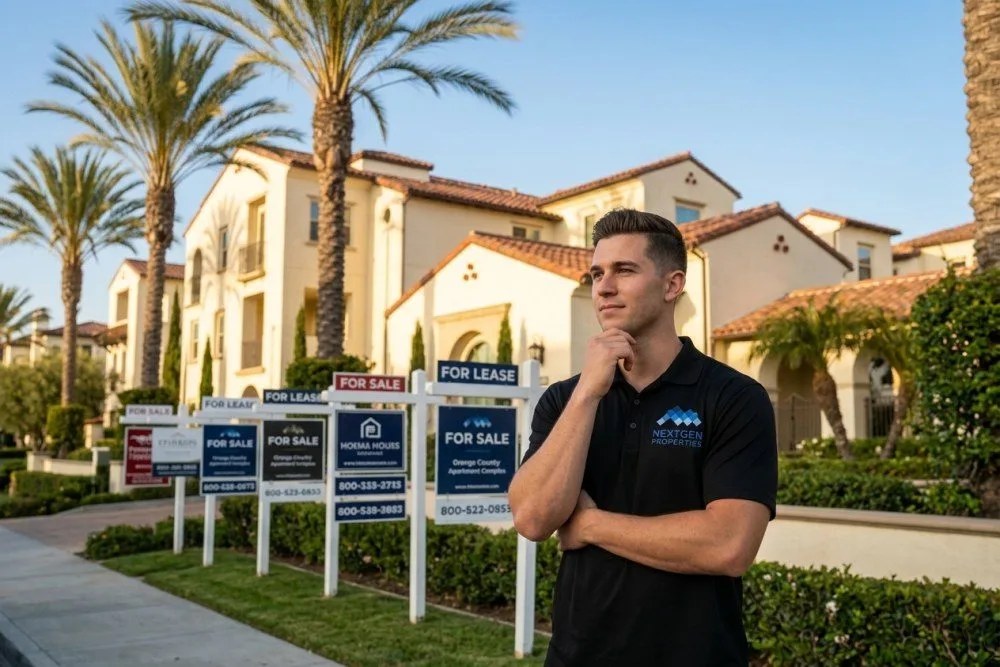
The days on market metric tells the complete story. Properties that historically sold within 45-60 days now average 120-150 days, with many listings going stale and requiring price reductions or withdrawal. This extended marketing period reflects both buyer caution and seller reluctance to accept current market pricing.
Interest Rate Impact and Financing Constraints
Interest rates remain the primary driver of market dysfunction. Commercial multifamily loans currently price at 7.25-7.75% for qualified borrowers, compared to 3.5-4.25% during the 2020-2022 period. This 350-400 basis point increase has fundamentally altered investment returns and cash flow dynamics across all property types.
For context, a $10 million acquisition that previously required $2.5 million down with a 4% loan now demands $3-3.5 million down with a 7.5% rate, increasing annual debt service by approximately $210,000. These financing constraints have eliminated many potential buyers and forced others to significantly lower their bid prices to maintain target returns.
Transaction volume peaked in 2022 before declining sharply, with 2026 on pace for the lowest activity since 2012.
| Year | Transaction Volume |
|---|---|
| 2020 | $2.1B |
| 2021 | $3.8B |
| 2022 | $4.2B |
| 2023 | $2.3B |
| 2024 | $1.8B |
| 2025 | $1.4B |
| 2026 Projected | $1.6B |
Bank lending has become increasingly conservative, with many regional banks reducing their commercial real estate exposure. Loan-to-value ratios have compressed from 75-80% to 65-70%, and debt service coverage requirements have increased from 1.20x to 1.35x or higher. These tightened standards eliminate marginal deals and force buyers to bring significantly more equity.
Bridge lending and alternative financing have partially filled the gap, but at costs often exceeding 9-11%. While some buyers utilize these products for acquisitions, the economics rarely support long-term holds, creating additional pressure for quick value-add execution and refinancing.
Submarket Performance and Pricing Variations
Recovery timing will vary significantly across Orange County's diverse multifamily submarkets. Coastal markets including Newport Beach, Huntington Beach, and Laguna Beach have shown the most price resilience, with declines limited to 8-12% from peak values. These areas benefit from limited supply, high barriers to entry, and sustained rental demand from high-income tenants.
Conversely, inland submarkets such as Santa Ana, Anaheim, and Garden Grove have experienced steeper price corrections of 18-25%. These markets face greater competition from new supply, more price-sensitive tenant bases, and higher crime concerns that impact investor perception. However, these same markets may offer the best recovery opportunities for patient capital.

The South County markets of Irvine, Mission Viejo, and Laguna Hills represent a middle ground, with price declines of 12-16%. These submarkets benefit from strong demographics and school districts but face headwinds from new supply delivery and corporate relocations affecting employment.
Cap rate expansion has followed similar patterns, with coastal properties trading at 4.0-4.5% compared to 3.7-4.0% at the 2021 peak, while inland properties now require 5.2-5.8% yields versus previous 4.8-5.2% levels. This cap rate dispersion creates distinct risk-return profiles across submarkets.
Recovery Timeline and Market Signals
Based on historical cycles and current market dynamics, we project Orange County's multifamily investment sale recovery will begin in Q4 2027, with meaningful activity resumption in 2028. This timeline assumes Federal Reserve policy shifts toward accommodation in mid-2027 and commercial mortgage rates declining to 5.5-6.0% by early 2028.
Several key indicators will signal the recovery phase. First, transaction volume will increase 25-30% quarter-over-quarter for two consecutive quarters, indicating genuine buyer re-engagement rather than seasonal fluctuations. Second, the buyer-seller pricing gap will compress to 5-7%, allowing deals to close within 45-60 days rather than current extended timelines.
Third, institutional capital will return to the market, evidenced by insurance companies, pension funds, and private equity groups completing acquisitions. These buyers have remained absent since late 2022, and their return signals confidence in stabilized pricing and financing conditions.
Cap rates are expected to edge modestly higher through 2027 before compressing as financing costs stabilize and transaction volume recovers.
| Year | Average Cap Rate |
|---|---|
| 2024 | 4.7% |
| 2025 | 4.8% |
| 2026 | 5.0% |
| 2027 | 5.1% |
| 2028 | 4.9% |
| 2029 | 4.7% |
The recovery will likely be gradual rather than sharp, with transaction volume increasing 40-50% in 2028 compared to 2026 levels, reaching 70-80% of peak activity by 2029. Price recovery will lag volume recovery by 6-9 months, as increased activity doesn't immediately translate to higher values.
Strategic Timing for Sellers and Buyers
Sellers facing immediate liquidity needs should consider current market conditions as potentially the trough, particularly for well-located coastal properties. Waiting for full recovery may take 18-24 months, and the carrying costs, opportunity costs, and market risks may outweigh the potential price appreciation. However, sellers with flexibility should target Q2-Q3 2028 for optimal pricing.
For sellers of inland properties, the timing calculation differs significantly. These assets face the steepest current discounts but may experience the strongest recovery as investors seek yield. Sellers who can hold through the cycle may see 20-30% price appreciation from current levels by 2029.
Buyers should focus on the next 12-18 months as the optimal acquisition window. Current pricing reflects significant discounts, financing costs have likely peaked, and rental fundamentals remain strong across most OC submarkets. The key is identifying properties where current cash flows can service debt while waiting for refinancing opportunities in 2028-2029.
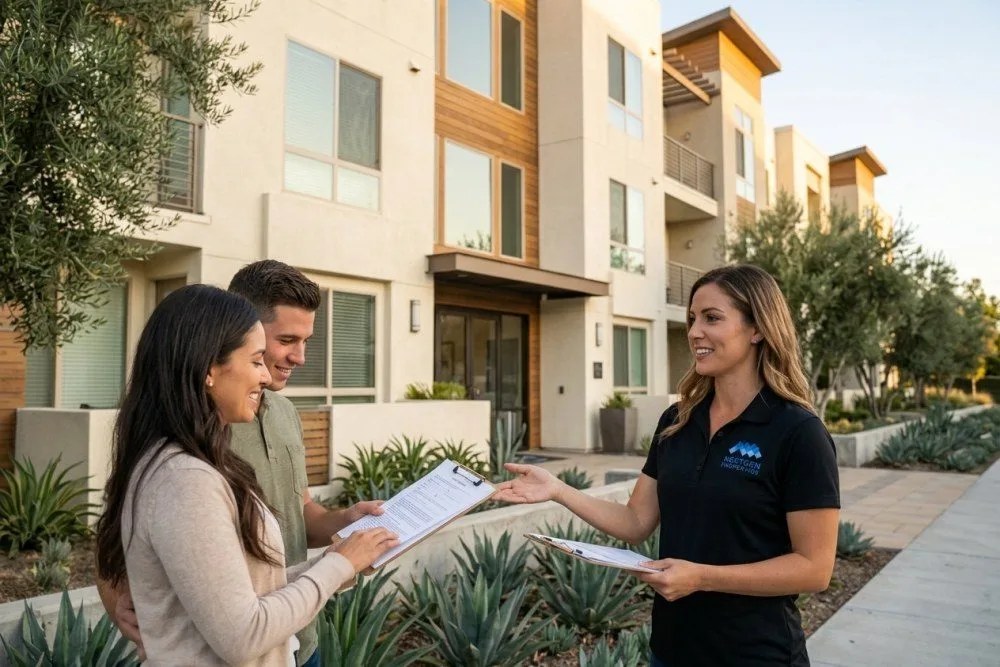
Value-add opportunities present the strongest risk-adjusted returns in the current environment. Properties requiring renovation or repositioning can be acquired at significant discounts, and the 18-24 month improvement timeline aligns well with projected market recovery. However, buyers must carefully underwrite construction costs and exit cap rates to avoid being trapped in negative equity positions.
Financing Market Evolution and Credit Availability
The financing landscape will undergo significant changes during the recovery period. Regional banks currently reducing commercial real estate exposure will likely remain conservative through 2027, creating opportunities for alternative lenders, credit unions, and private debt funds to capture market share.
CMBS lending, which virtually disappeared in 2023-2024, should return in limited form by late 2027 as spreads widen sufficiently to attract investor demand. However, underwriting standards will remain tighter than historical norms, with debt service coverage requirements likely staying above 1.30x and loan-to-value ratios capped at 70-75%.
Life insurance companies and pension funds will re-engage as anchor lenders for institutional-quality properties, but their focus will emphasize newer construction, strong sponsorship, and conservative leverage. These lenders may drive a bifurcated market where trophy assets access favorable financing while secondary properties rely on more expensive alternatives.
Bridge lending will remain active but expensive, with rates likely staying above 8% through the recovery period. This creates a clear incentive for buyers to seek properties that can qualify for permanent financing rather than relying on transitional debt structures.
Rental Market Fundamentals Supporting Recovery
Orange County's rental fundamentals remain strong despite investment sale market challenges. Average rent growth of 4-6% annually continues across most submarkets, supported by limited new supply delivery and sustained in-migration from higher-cost coastal markets. Vacancy rates have stabilized at 3-4% countywide, well below the 5-6% levels that would indicate oversupply.
The disconnect between strong operational performance and weak investment sales creates opportunity for patient investors. Properties generating stable cash flows at current rent levels should benefit from continued organic growth, while the sales market pricing reflects excessive pessimism about future performance.
Demographic trends support continued rental demand, with Orange County adding 15,000-20,000 jobs annually in healthcare, technology, and professional services. These employment sectors generate tenant demand for quality multifamily housing, particularly as homeownership remains challenging due to median home prices exceeding $1.1 million.
Supply constraints will persist due to entitlement challenges, construction costs, and local resistance to density increases. This supply-demand imbalance supports rent growth and occupancy levels that underpin investment fundamentals, even as transaction pricing remains depressed.
Investment Strategy Recommendations by Market Phase
Current Phase (2026-Early 2027): Focus on acquiring distressed or motivated seller opportunities in prime locations. Target properties with in-place cash flows that can service debt at current rates, avoiding speculative value-add deals requiring perfect execution. Consider shorter-hold strategies that can realize value within 2-3 years rather than traditional 5-7 year holds.
Early Recovery (Late 2027-2028): Shift toward quality value-add opportunities as financing costs moderate and exit visibility improves. Properties requiring 12-18 months of improvements should benefit from recovering transaction markets upon completion. Begin targeting institutional-quality assets that will benefit most from returning capital flows.
Full Recovery (2029+): Emphasize portfolio optimization and strategic dispositions of properties held through the cycle. Market conditions should support premium pricing for well-positioned assets, creating opportunities to harvest gains and redeploy capital into new opportunities.
Throughout all phases, submarket selection remains critical. Coastal and South County properties offer stability but limited upside, while inland markets provide greater appreciation potential at higher risk levels. Diversification across submarkets and property types can optimize risk-adjusted returns while maintaining liquidity options.
Frequently Asked Questions