
Costa Mesa stands as Orange County's largest city without rent control, but mounting advocacy pressure and neighboring cities' ordinances create uncertainty for multifamily investors. While the city currently operates under California's statewide Tenant Protection Act (TPO), which caps annual rent increases at 5% plus local inflation, activists continue pushing for stronger local protections. Understanding the distinction between TPO's baseline requirements and potential full rent control implementation is critical for portfolio strategy. We've analyzed Costa Mesa's regulatory trajectory, neighboring cities' approaches, and market implications to help landlords prepare for multiple scenarios while maximizing returns under current law.
Costa Mesa's Current Regulatory Landscape
Costa Mesa operates exclusively under California's Tenant Protection Act (TPO), implemented statewide in January 2020. Unlike neighboring Santa Ana or Irvine, Costa Mesa has no local rent stabilization ordinance, making it one of Orange County's most landlord-friendly major markets. The TPO provides baseline tenant protections without the complex administrative layers found in cities with full rent control.
Under TPO, Costa Mesa landlords face annual rent increase caps of 5% plus local inflation, with a maximum ceiling of 10% regardless of inflation rates. For 2026, this translates to approximately 7.2% maximum increases based on current LA-Orange County CPI data. Properties built within the past 15 years remain exempt from these restrictions, covering most developments constructed after 2009.
The TPO also requires "just cause" eviction protections after tenants reach 12 months of occupancy. Landlords must provide specific legal grounds for eviction and follow prescribed notice periods. However, Costa Mesa hasn't layered additional local requirements onto these state mandates, unlike cities with comprehensive rent control ordinances.

Property managers in our Costa Mesa portfolio report significantly streamlined compliance compared to Santa Ana properties. TPO's standardized statewide framework eliminates the patchwork of local interpretations that plague rent-controlled markets. However, this regulatory simplicity may not persist indefinitely given current political pressures.
TPO Mechanics and Compliance Requirements
The Tenant Protection Act establishes clear operational parameters that Costa Mesa landlords must follow. Rent increase calculations use the previous 12-month period's Consumer Price Index for the LA-Orange County metropolitan area, published by the Bureau of Labor Statistics. Landlords must provide 30-day written notice for increases under 10% and 90-day notice for increases of 10% or more.
TPO's just cause eviction framework divides grounds into two categories: "at-fault" and "no-fault" reasons. At-fault evictions include nonpayment of rent, lease violations, illegal activities, and refusal to execute lease renewals with similar terms. No-fault evictions cover owner move-in, substantial rehabilitation, demolition, and permanent removal from rental market. No-fault evictions require relocation assistance equal to one month's rent.
Exemptions under TPO include single-family homes and condos (unless owned by a corporation, REIT, or LLC in which at least one member is a corporation), duplexes where owners occupy one unit, housing constructed within 15 years, and deed-restricted affordable housing. These exemptions cover approximately 35% of Costa Mesa's rental stock based on our market analysis.
Documentation and Notice Requirements
Costa Mesa landlords must maintain detailed rent increase documentation showing CPI calculations and compliance with percentage caps. We recommend using the California Department of Housing and Community Development's official rent increase worksheets, which provide legal defensibility if tenant challenges arise. Notice delivery methods must follow Civil Code Section 1946 requirements, with certified mail being the most protective option.
Banking relationships become crucial under TPO since security deposit handling rules carry severe penalties for violations. California's new AB 12 (effective 2024) requires detailed security deposit accounting, including itemized deductions and photographic evidence for damage claims. Costa Mesa hasn't added local layers to these requirements, but compliance remains complex.
Rent Control Advocacy Pressure and Timeline
Costa Mesa faces intensifying pressure from tenant advocacy groups, particularly the Costa Mesa Tenants Union and Orange County Communities Organized for Responsible Development (OCCORD). These organizations have successfully pushed rent control measures in neighboring cities and view Costa Mesa as a priority target given its large rental population and absence of local protections.
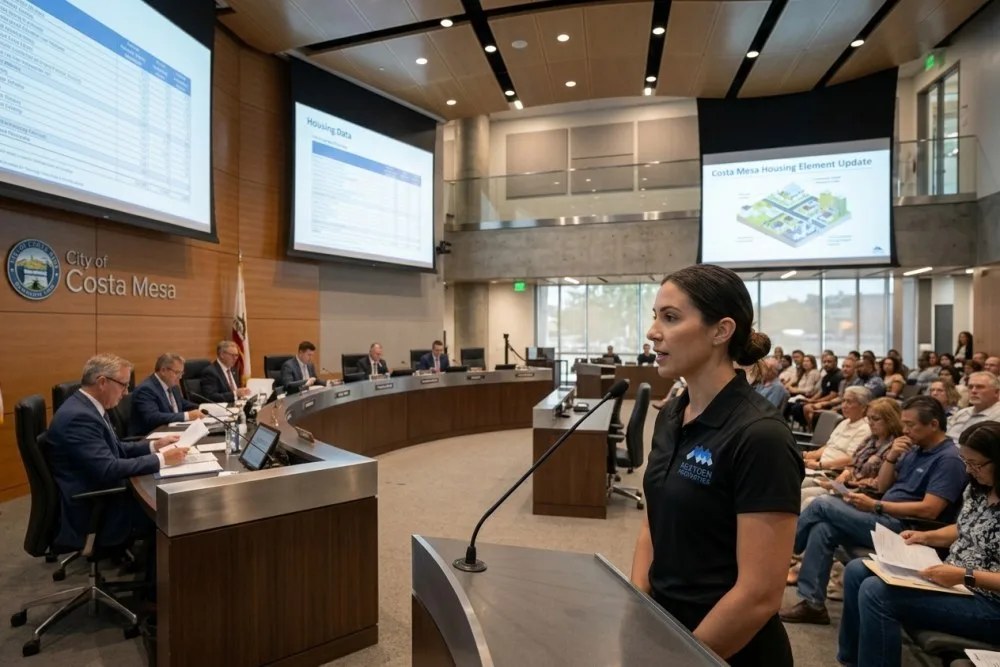
The advocacy timeline accelerated following Costa Mesa's housing element approval in 2023, which rezoned significant areas for higher-density development. Tenant groups argue that increased development pressure creates displacement risks requiring proactive rent stabilization measures. City Council meetings since January 2025 have featured regular public comment periods demanding rent control studies.
Political dynamics shifted in November 2024 when two council candidates expressing openness to rent control studies won seats. While not explicitly pro-rent control, Councilmembers Jennifer Nguyen and Maria Rodriguez have committed to "exploring all housing affordability tools." This creates a potential 3-2 majority for rent control study authorization if Mayor John Stephens shifts positions.
The advocacy strategy mirrors successful campaigns in Santa Ana and other OC cities, focusing on displacement narratives and affordability crises. However, Costa Mesa's higher median income and homeownership rates may limit political traction compared to heavily rental markets like Santa Ana or Anaheim.
Comparison with Neighboring Cities' Ordinances
Santa Ana's rent stabilization ordinance provides the closest comparison for potential Costa Mesa regulations. Santa Ana caps annual increases at 3% or 80% of CPI growth, whichever is lower, with a 3% maximum ceiling. The ordinance covers buildings with two or more units built before February 1995, affecting approximately 75% of Santa Ana's rental stock. Administrative costs include $150 annual registration fees and mandatory relocation assistance of $1,000-$5,000 for no-fault evictions.
Irvine currently operates under TPO without additional local rent control measures, though tenant advocacy groups have pushed for enhanced protections. The city's higher median income and homeownership rates reduce political pressure for rent stabilization compared to Costa Mesa's more renter-heavy demographics.
Huntington Beach maintains a TPO-only approach similar to Costa Mesa but faces less advocacy pressure due to its higher homeownership rates and different demographic composition. Newport Beach and Laguna Beach rely on TPO with minimal local modifications, though their luxury market dynamics differ significantly from Costa Mesa's workforce housing focus.
Administrative Burden Comparison
Our property management division tracks compliance costs across OC markets. Santa Ana properties require 15-20 hours monthly of additional administrative work for rent control compliance, including registration updates, CPI calculations, and enhanced tenant communications. Costa Mesa properties under TPO-only require approximately 3-4 hours monthly for documentation and notice compliance.
Registration and fee structures vary dramatically. Santa Ana charges $150 annually per unit plus late penalties. Costa Mesa currently has no registration requirements beyond basic business license compliance. If Costa Mesa implements rent control, fee structures will significantly impact small property owner economics.
Full Rent Control Implementation: Market Implications
Costa Mesa landlords can raise rents 7.2% annually under TPO while Santa Ana caps increases at just 3% — more than double the income growth potential
Should Costa Mesa implement comprehensive rent control, market dynamics would shift dramatically. Based on our analysis of Santa Ana's post-ordinance trends, immediate effects include 15-25% increases in tenant screening criteria as landlords seek to minimize future regulatory risks. Properties approaching rent control coverage thresholds experience accelerated rent increases in the months before implementation.
Construction economics face severe impacts under full rent control scenarios. New development pencils become increasingly difficult as developers factor long-term rent growth limitations into pro formas. Costa Mesa's housing element goals of 19,000+ new units by 2029 could face significant headwinds if rent control reduces development feasibility. We've seen similar patterns in Santa Ana, where multifamily permits declined 40% following ordinance implementation.
Investment sales markets react negatively to rent control implementation. Cap rates typically compress 25-50 basis points in the year following ordinance adoption as investors demand higher yields to offset regulatory risks. However, existing rent-controlled properties may see value premiums if they maintain grandfathered tenant bases at below-market rents, creating complex valuation scenarios.
Property maintenance and capital expenditure patterns change under rent control. Limited rent growth potential reduces landlord incentives for major improvements, leading to gradual stock deterioration. Santa Ana has addressed this through mandatory habitability inspection programs, adding further compliance costs. Costa Mesa would likely implement similar measures, increasing operational complexity.
Strategic Positioning for Landlords
Costa Mesa landlords should implement defensive strategies while rent control remains uncertain. Document all property improvements and maintenance investments to support future rent increase justifications under any regulatory framework. Establish detailed tenant screening protocols that comply with fair housing requirements while identifying reliable, long-term residents who reduce turnover costs.
Lease structuring becomes critical in uncertain regulatory environments. Consider implementing annual lease renewals with escalation clauses tied to CPI increases, ensuring compliance with current TPO limits while maintaining flexibility. Avoid long-term leases that could lock in below-market rents if rent control delays implementation. Our legal team recommends reviewing all lease templates for regulatory adaptability.

Portfolio diversification across regulatory environments provides risk management benefits. Balance Costa Mesa holdings with properties in rent-controlled and TPO-only markets to smooth regulatory impacts. Consider geographic diversification beyond Orange County, as markets like Arizona offer different regulatory frameworks with potentially superior risk-adjusted returns.
Technology and Compliance Systems
Implement comprehensive property management software capable of handling multiple regulatory frameworks. Systems must track CPI adjustments, notice requirements, security deposit accounting, and maintenance requests with audit trail capabilities. Cloud-based platforms offer scalability as compliance requirements potentially expand under future rent control scenarios.
Establish relationships with experienced legal counsel specializing in California landlord-tenant law. Regulatory interpretation varies significantly between jurisdictions, and local expertise becomes invaluable during ordinance implementation periods. Budget for increased legal costs during transition periods as new regulations create interpretation uncertainties.
Investment Implications and Market Outlook
Costa Mesa's rental market presents compelling opportunities under current TPO-only regulations, but potential rent control implementation creates valuation uncertainties. Near-term strategies should focus on value-add properties where immediate improvements can justify rent increases before potential regulatory restrictions. Properties built after 2009 maintain exemption status under most rent control frameworks, providing defensive positioning.
Development opportunities remain attractive given Costa Mesa's housing element commitments and current regulatory environment. However, investors should model multiple regulatory scenarios in pro forma analysis. Include potential rent control impacts on stabilized NOI projections and factor administrative cost increases into operating assumptions. Conservative underwriting assumes rent control implementation within 5-7 years based on current political trajectories.
Acquisition strategies should prioritize properties with established tenant bases and documented improvement needs. Properties requiring significant deferred maintenance may struggle to generate adequate returns under restrictive rent control scenarios. Focus on assets where current rents approximate market levels, minimizing displacement risks that fuel additional regulatory pressure.
Financing and Capital Allocation
Lender attitudes toward Costa Mesa properties remain favorable given the current regulatory environment, but this could shift rapidly following rent control implementation. Secure long-term, fixed-rate financing where possible to minimize refinancing risks during potential regulatory transitions. Consider interest-only periods to improve cash flow if rent growth becomes constrained by future ordinances.
Capital allocation should emphasize projects generating immediate cash flow improvements rather than speculative appreciation plays. Energy efficiency upgrades, unit reconfiguration, and amenity improvements provide defensible rent increase justifications under most regulatory frameworks. Avoid highly leveraged value-add strategies that depend on aggressive rent growth assumptions.
Monitoring and Civic Engagement Strategies
Active monitoring of Costa Mesa's political landscape provides early warning of regulatory changes. Track City Council agendas, planning commission discussions, and public comment periods for housing-related items. Subscribe to city newsletter updates and follow local media coverage of housing policy debates. The Daily Pilot and Voice of OC provide reliable coverage of Costa Mesa municipal affairs.
Consider strategic civic engagement through landlord associations and business organizations. The Costa Mesa Chamber of Commerce and Orange County Apartment Association provide platforms for industry advocacy and information sharing. Professional property management companies often maintain government affairs resources that benefit client portfolios through active policy monitoring.
Establish relationships with Costa Mesa planning and code enforcement staff to understand current interpretation of existing regulations. Building positive working relationships with city staff facilitates smoother compliance under any regulatory framework and provides early insight into potential policy changes. Professional property managers with established city relationships add significant value during uncertain regulatory periods.
Documentation and Advocacy Preparation
Maintain detailed records of all tenant interactions, property improvements, and market conditions to support potential advocacy efforts if rent control consideration accelerates. Document positive landlord-tenant relationships, property investment levels, and community contributions to counter negative narratives often associated with rent control campaigns.
Prepare economic impact data showing property tax contributions, local employment creation, and housing stock maintenance investments. This information becomes valuable if City Council requests stakeholder input during rent control study processes. Professional documentation of portfolio contributions to Costa Mesa's housing stability strengthens industry advocacy positions.
Frequently Asked Questions